
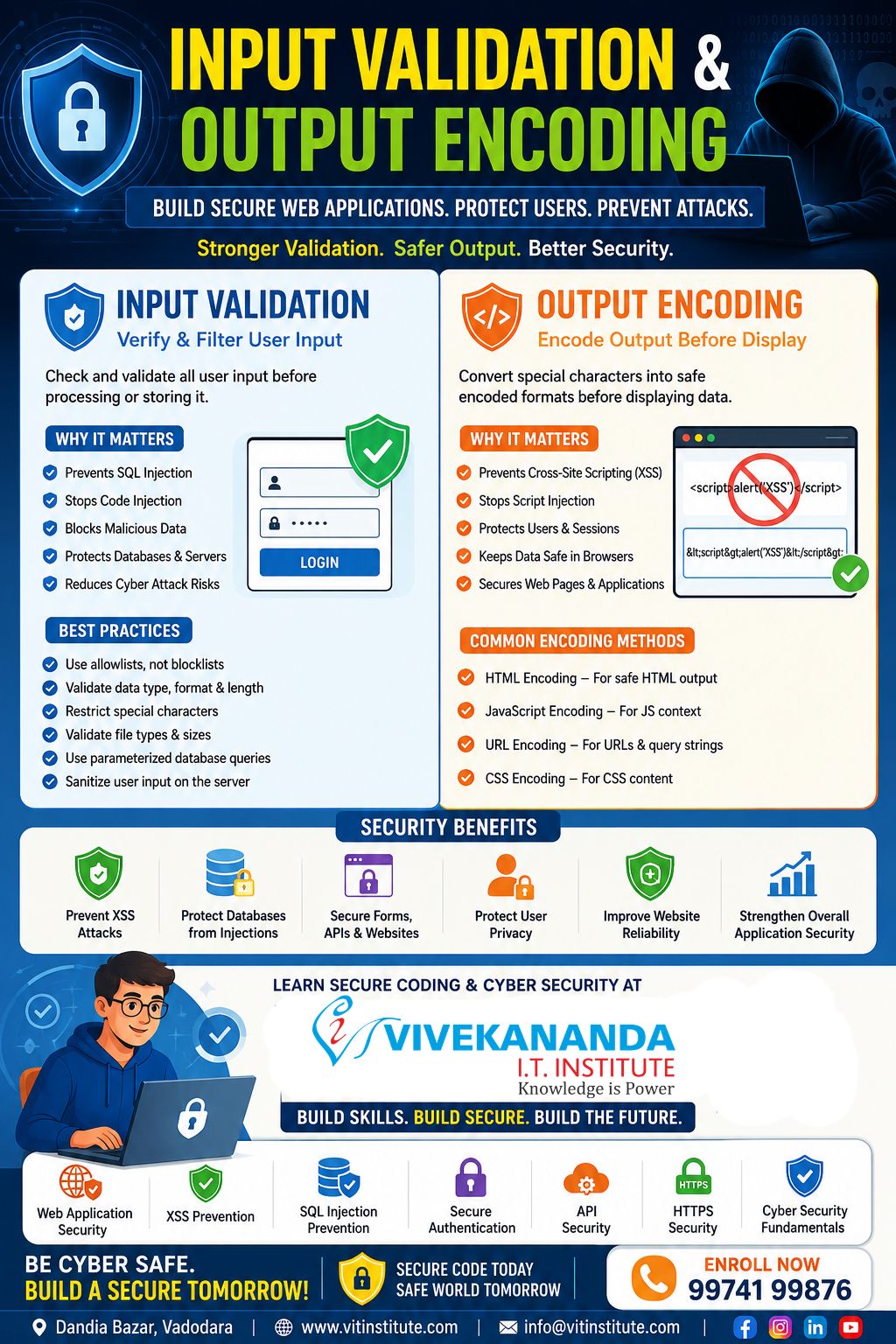
In today’s digital environment, web applications constantly interact with user-generated data through forms, search boxes, APIs, login pages, and file uploads. While this interaction enhances user experience, it also creates opportunities for cyber attacks if proper security measures are not implemented.
Two of the most important secure coding practices are Input Validation and Output Encoding. These techniques help protect websites, web applications, databases, and users from common vulnerabilities such as Cross-Site Scripting (XSS), SQL Injection, Command Injection, and other malicious attacks.
At Vivekananda IT Institute, Baroda, students learn modern web security concepts and secure development practices that are essential for building reliable and secure applications in today’s cybersecurity landscape.
What is Input Validation?
Input Validation is the process of checking, verifying, and filtering user-provided data before it is processed, stored, or transmitted by an application.
Every time users submit information such as:
- Login credentials
- Registration details
- Contact form entries
- Search queries
- Payment information
- File uploads
- API requests
the application must verify that the data is valid, expected, and safe.
Input validation acts as the first line of defense against malicious inputs designed to exploit application vulnerabilities.
Why Input Validation is Important
Without proper validation, attackers can manipulate applications by submitting malicious data that may lead to:
- SQL Injection attacks
- Cross-Site Scripting (XSS)
- Command Injection
- Remote Code Execution
- Authentication Bypass
- Data Manipulation
- Unauthorized Access
- Server Compromise
Strong input validation significantly reduces the attack surface and helps maintain application integrity and security.
Types of Input Validation
1. Client-Side Validation
Client-side validation is performed within the user’s browser, typically using JavaScript.
Common examples include:
- Mandatory field validation
- Email format verification
- Password strength checks
- Numeric field validation
While client-side validation improves usability and user experience, it should never be relied upon for security because attackers can bypass it easily.
2. Server-Side Validation
Server-side validation occurs on the application’s backend before any data processing takes place.
This validation checks:
- Data type
- Length
- Format
- Allowed values
- Business rules
Since all requests ultimately reach the server, server-side validation is the most critical security layer.
Best Practices for Secure Input Validation
To strengthen application security, developers should follow these best practices:
Use Allowlisting
Accept only predefined valid inputs rather than attempting to block malicious ones.
Example:
Allow only:
- Letters
- Numbers
- Specific symbols
instead of trying to identify every possible malicious character.
Validate Data Types
Ensure input matches the expected format.
Examples:
- Age should be numeric
- Email should follow email syntax
- Date fields should contain valid dates
Restrict Input Length
Limit the size of user inputs to prevent buffer overflow attacks and resource abuse.
Validate File Uploads
Check:
- File extensions
- MIME types
- File size
- File content
before accepting uploaded files.
Sanitize User Input
Remove or neutralize unnecessary or potentially dangerous characters before processing data.
Use Parameterized Queries
Parameterized database queries prevent attackers from injecting malicious SQL commands.
What is Output Encoding?
Output Encoding is the process of converting potentially dangerous characters into safe encoded formats before displaying data to users.
Even if malicious content enters an application, proper encoding prevents browsers from interpreting it as executable code.
Output encoding ensures that user-generated content is displayed as text rather than executed as scripts.
Why Output Encoding Matters
Applications frequently display data submitted by users.
Examples include:
- Blog comments
- Reviews
- Forum posts
- User profiles
- Search results
If this content is displayed without encoding, attackers can inject scripts that execute within the victim’s browser.
This attack is known as Cross-Site Scripting (XSS).
Consequences of XSS attacks include:
- Session hijacking
- Cookie theft
- Credential theft
- Identity impersonation
- Data exposure
- Malware delivery
Proper output encoding effectively prevents these risks.
Common Output Encoding Techniques
HTML Encoding
Used when displaying data inside HTML pages.
Special characters are converted into safe HTML entities.
Examples:
<becomes<>becomes>"becomes"
This prevents browsers from treating user input as HTML code.
JavaScript Encoding
Used when inserting dynamic content into JavaScript code.
Special characters are encoded to prevent script injection.
URL Encoding
Used when user data is included in URLs and query parameters.
This prevents URL manipulation and injection attacks.
CSS Encoding
Used when user-supplied data is inserted into CSS contexts.
It helps prevent malicious CSS-based attacks.
Security Benefits of Input Validation and Output Encoding
When implemented correctly, these techniques provide several cybersecurity advantages:
- Prevent Cross-Site Scripting (XSS)
- Reduce SQL Injection risks
- Protect databases and backend systems
- Secure forms and APIs
- Improve application reliability
- Protect sensitive user information
- Strengthen overall application security
- Support compliance with security standards
- Minimize data breach risks
- Build user trust and confidence
Real-World Applications
Input Validation and Output Encoding are used across various technologies and platforms, including:
E-Commerce Websites
Protect payment forms, checkout pages, and customer accounts.
Banking Applications
Secure financial transactions and user authentication systems.
Social Media Platforms
Prevent malicious scripts in posts, comments, and messages.
Healthcare Systems
Protect sensitive patient information and medical records.
Government Portals
Ensure secure handling of citizen data and online services.
APIs and Cloud Applications
Validate requests and secure data exchange between systems.
Role of Vivekananda IT Institute, Baroda in Cyber Security Education
As cyber threats continue to evolve, understanding secure coding practices has become an essential skill for developers and cybersecurity professionals.
Vivekananda IT Institute, Baroda provides practical exposure to modern web security concepts, including:
- Input Validation
- Output Encoding
- Cross-Site Scripting (XSS) Prevention
- SQL Injection Prevention
- Secure Authentication
- HTTPS Security
- API Security
- Secure Coding Standards
- Web Application Security Testing
- Cyber Security Fundamentals
These industry-relevant topics help students develop the knowledge and skills needed to build secure, reliable, and professional web applications.
Conclusion
Input Validation and Output Encoding are fundamental pillars of secure web development and cybersecurity. By validating all incoming data and safely encoding outgoing content, developers can prevent many of the most common and dangerous web application vulnerabilities.
Organizations that implement these security practices significantly reduce their exposure to cyber threats while protecting user data and maintaining system integrity.
Through practical cybersecurity and web development training, Vivekananda IT Institute, Baroda continues to equip students with the skills required to build safer, smarter, and more secure digital solutions for the future.