
Advanced Network Attacks: Understanding Modern Cyber Threats and Protection Strategies
In today’s hyper-connected digital world, cyberattacks are becoming more sophisticated and dangerous. Organizations, businesses, and even individuals are constantly targeted by hackers who exploit weaknesses in networks and systems. Understanding advanced network attacks is one of the most important skills for aspiring cybersecurity professionals.
At Vivekananda IT Institute, students learn how modern cyber threats operate and how professionals defend against them using real-world cybersecurity techniques. The institute in Vadodara provides practical training in ethical hacking, penetration testing, and network security to prepare students for the growing cybersecurity industry.
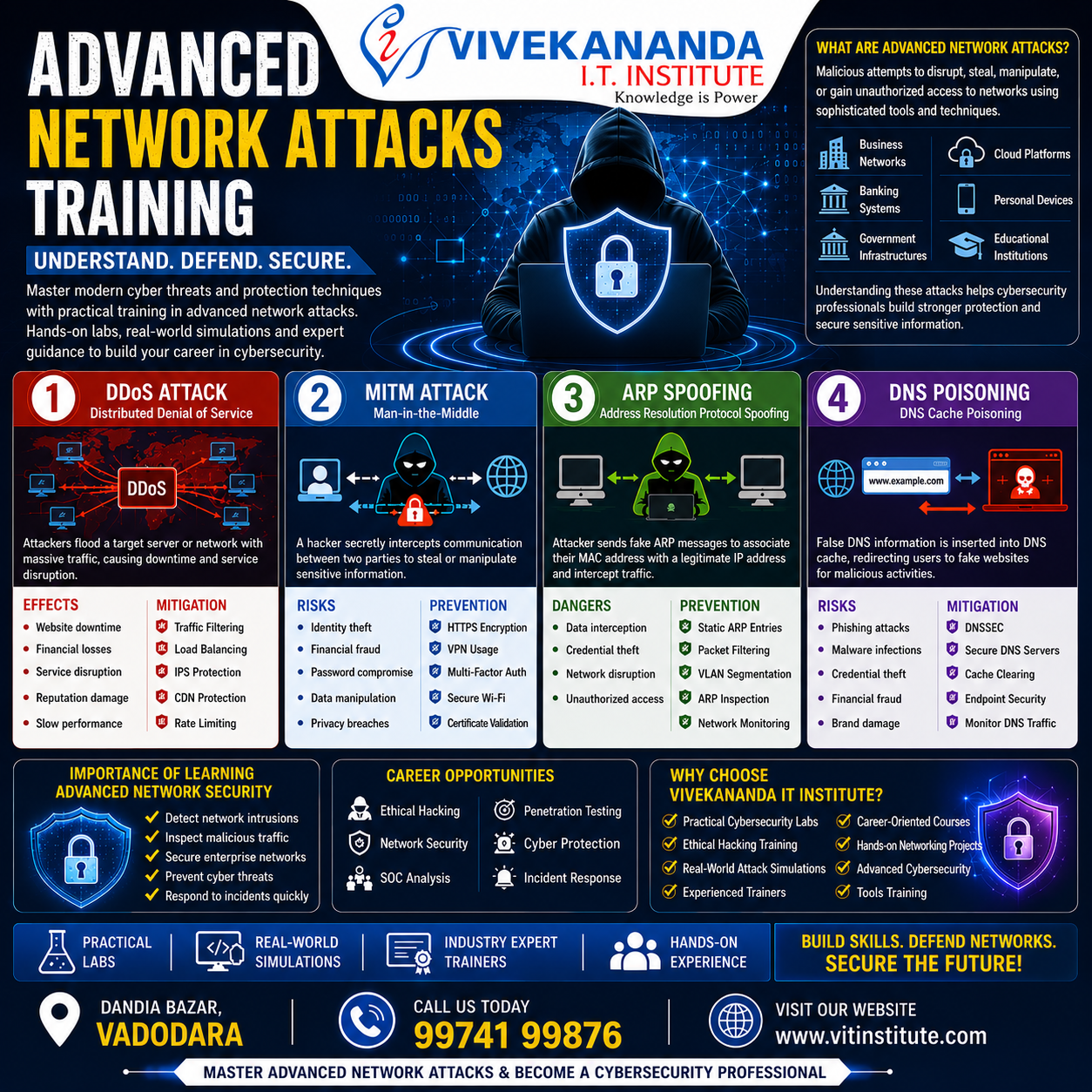
What Are Advanced Network Attacks?
Advanced network attacks are malicious attempts to disrupt, steal, manipulate, or gain unauthorized access to computer networks. These attacks are often carried out using sophisticated tools and techniques that bypass traditional security systems.
Cybercriminals target:
- Business networks
- Banking systems
- Government infrastructures
- Cloud platforms
- Personal devices
- Educational institutions
Understanding these attacks helps cybersecurity professionals build stronger protection systems and secure sensitive information.
1. Distributed Denial of Service (DDoS) Attack
What is a DDoS Attack?
A Distributed Denial of Service (DDoS) attack occurs when multiple systems flood a target server, website, or network with massive amounts of traffic. The goal is to overwhelm the system and make services unavailable to legitimate users.
Imagine thousands of fake visitors entering a shopping mall at the same time, blocking real customers from entering. That is exactly how a DDoS attack works in the digital world.
How DDoS Attacks Work
Attackers usually use:
- Botnets (infected computers)
- IoT devices
- Malware-controlled systems
These compromised devices simultaneously send huge traffic requests to the victim’s server.
Common Types of DDoS Attacks
1. Volume-Based Attacks
Flood the network bandwidth with enormous traffic.
2. Protocol Attacks
Exploit weaknesses in protocols like TCP/IP.
3. Application Layer Attacks
Target applications such as HTTP and web servers.
Effects of DDoS Attacks
- Website downtime
- Financial losses
- Service disruption
- Damage to company reputation
- Slow network performance
DDoS Mitigation Techniques
Traffic Filtering
Firewalls and routers filter malicious traffic.
Load Balancing
Traffic is distributed across multiple servers.
Intrusion Prevention Systems (IPS)
Detects and blocks abnormal traffic patterns.
CDN Protection
Content Delivery Networks absorb attack traffic.
Rate Limiting
Restricts excessive requests from users.
At Vivekananda IT Institute, students learn how enterprise-grade DDoS protection systems work in real cybersecurity environments.
2. Man-in-the-Middle (MITM) Attack
What is a MITM Attack?
A Man-in-the-Middle (MITM) attack happens when a hacker secretly intercepts communication between two parties.
The attacker can:
- Steal sensitive data
- Modify communication
- Capture passwords
- Monitor online activities
For example, when a user logs into online banking using an unsecured Wi-Fi network, an attacker may intercept the communication without the user knowing.
How MITM Attacks Work
The attacker positions themselves between:
- User and website
- User and router
- Client and server
The communication appears normal, but the attacker secretly listens to or manipulates the data.
Common MITM Techniques
Session Hijacking
Stealing active user sessions.
Evil Twin Wi-Fi
Creating fake public Wi-Fi networks.
SSL Stripping
Downgrading HTTPS connections to HTTP.
Packet Sniffing
Capturing unencrypted network packets.
Risks of MITM Attacks
- Identity theft
- Financial fraud
- Password compromise
- Data manipulation
- Privacy breaches
MITM Attack Prevention
Use HTTPS Encryption
Secure communication using SSL/TLS.
VPN Usage
Encrypts internet traffic on public networks.
Multi-Factor Authentication (MFA)
Adds additional security layers.
Secure Wi-Fi Networks
Avoid public unsecured Wi-Fi.
Certificate Validation
Ensures secure website authenticity.
Students at Vivekananda IT Institute gain hands-on experience in detecting and preventing MITM attacks using ethical hacking labs and cybersecurity tools.
3. ARP Spoofing Attack
What is ARP Spoofing?
ARP (Address Resolution Protocol) spoofing is a network attack where an attacker sends fake ARP messages on a local network.
The goal is to associate the attacker’s MAC address with the IP address of a legitimate device.
This allows attackers to:
- Intercept network traffic
- Steal sensitive data
- Launch MITM attacks
How ARP Spoofing Works
Normally, devices use ARP to map IP addresses to MAC addresses.
In ARP spoofing:
- The attacker sends fake ARP responses.
- Devices update their ARP cache incorrectly.
- Traffic gets redirected to the attacker.
The victim remains unaware while the attacker monitors communication.
Dangers of ARP Spoofing
- Data interception
- Credential theft
- Network disruption
- Unauthorized access
ARP Spoofing Prevention
Static ARP Entries
Prevent unauthorized ARP modifications.
Packet Filtering
Detect suspicious ARP packets.
VLAN Segmentation
Separates sensitive network traffic.
ARP Inspection
Switches validate ARP requests.
Network Monitoring Tools
Identify abnormal ARP activities.
At Vivekananda IT Institute, students learn advanced network monitoring using tools like Wireshark to inspect ARP spoofing attacks in real-time.
4. DNS Poisoning Attack
What is DNS Poisoning?
DNS poisoning, also called DNS cache poisoning, is an attack where false DNS information is inserted into a DNS server cache.
As a result:
- Users are redirected to fake websites
- Login credentials are stolen
- Malware gets distributed
Even when users type the correct website address, they may unknowingly visit a malicious website.
How DNS Poisoning Works
- Attacker compromises DNS records.
- Fake IP addresses are stored in DNS cache.
- Users are redirected to malicious servers.
The fake website often looks identical to the original one.
Risks of DNS Poisoning
- Phishing attacks
- Malware infections
- Credential theft
- Financial fraud
- Brand reputation damage
DNS Poisoning Mitigation Techniques
DNSSEC (DNS Security Extensions)
Authenticates DNS responses.
Secure DNS Servers
Use trusted DNS providers.
Regular DNS Cache Clearing
Removes malicious entries.
Endpoint Security
Detects malicious redirections.
Monitoring DNS Traffic
Identifies unusual DNS activity.
Cybersecurity learners at Vivekananda IT Institute study DNS attack simulations to understand how attackers manipulate internet traffic.
Importance of Learning Advanced Network Security
As cyberattacks continue to evolve, companies require skilled cybersecurity professionals who can:
- Detect network intrusions
- Inspect malicious traffic
- Secure enterprise networks
- Prevent cyber threats
- Respond to incidents quickly
Learning advanced network attacks is essential for careers in:
- Ethical Hacking
- Network Security
- SOC Analysis
- Penetration Testing
- Cyber Protection
- Incident Response
Why Choose Vivekananda IT Institute in Vadodara?
Vivekananda IT Institute offers industry-focused cybersecurity and networking training designed for beginners and advanced learners.
Key Highlights
- Practical cybersecurity labs
- Ethical hacking training
- Real-world attack simulations
- Experienced trainers
- Career-oriented courses
- Hands-on networking projects
- Advanced cybersecurity tools training
Students in Vadodara receive professional guidance to build strong careers in the rapidly growing cybersecurity field.
Final Thoughts
Advanced network attacks like DDoS, MITM, ARP spoofing, and DNS poisoning are major threats in today’s digital environment. Understanding how these attacks work and learning effective mitigation techniques are critical skills for cybersecurity professionals.
With proper training from institutions like Vivekananda IT Institute, students can master advanced cybersecurity concepts and become capable of defending modern networks against evolving cyber threats.
The future of cybersecurity belongs to skilled professionals who understand both attack strategies and defensive technologies.