
In today’s digital environment, websites and web applications frequently allow users to upload files such as images, documents, PDFs, videos, and profile pictures. While this functionality enhances user experience and business operations, it also introduces significant cybersecurity risks if not properly secured.
A poorly implemented file upload system can provide attackers with a direct path to compromise servers, distribute malware, steal sensitive information, or disrupt services. Secure File Upload Handling is therefore a critical component of modern web development and cybersecurity.
At Vivekananda IT Institute, Baroda, students learn how secure coding practices and cybersecurity principles work together to protect applications from file upload-based attacks.
What is Secure File Upload Handling?
Secure File Upload Handling is the process of validating, processing, storing, and managing user-uploaded files in a way that prevents malicious activity and unauthorized access.
Without proper security controls, attackers may upload harmful files designed to:
- Execute malicious code
- Install malware or ransomware
- Create unauthorized access points
- Steal sensitive data
- Compromise web servers
- Disrupt application availability
Implementing secure upload mechanisms helps organizations reduce these risks and maintain a secure application environment.
Why File Upload Security Matters
File upload functionality is one of the most frequently targeted areas of web applications because it directly accepts user-supplied content.
A secure file upload system helps organizations:
- Protect customer and business data
- Prevent malware infections
- Reduce the risk of server compromise
- Improve overall application security
- Maintain website performance and reliability
- Build trust among users and customers
For developers and security professionals, understanding upload security is essential for building resilient web applications.
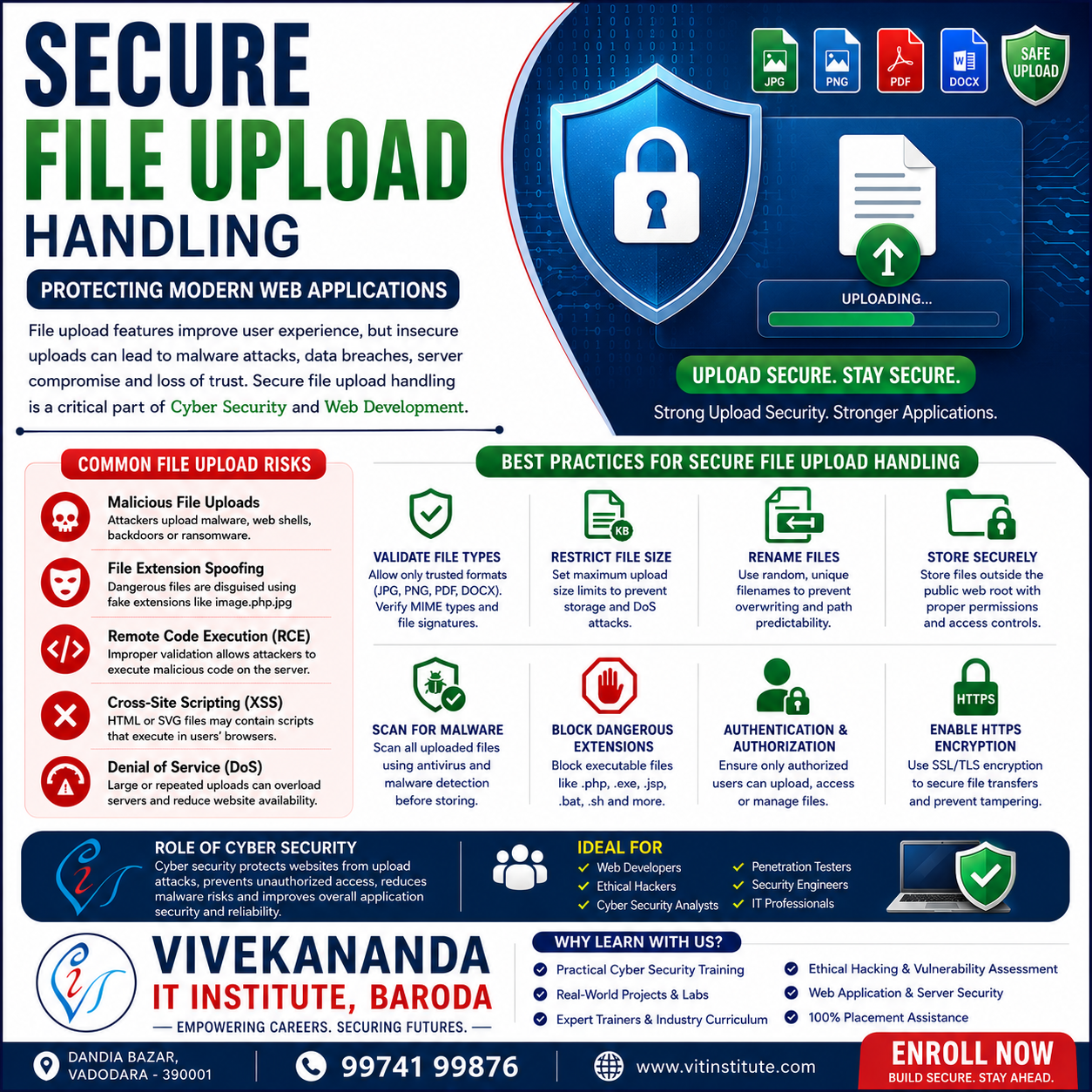
Common File Upload Security Risks
1. Malicious File Uploads
Attackers may upload files containing:
- Malware
- Web shells
- Backdoors
- Ransomware
If executed on the server, these files can provide attackers with complete control over the application environment.
2. File Extension Spoofing
Cybercriminals often disguise malicious files using double extensions such as:
- image.php.jpg
- document.exe.png
- report.jsp.pdf
Weak validation systems may incorrectly identify these files as safe.
3. Remote Code Execution (RCE)
Improper validation may allow uploaded scripts to execute directly on the server, resulting in full system compromise.
4. Cross-Site Scripting (XSS)
Certain file types, such as HTML and SVG files, can contain embedded JavaScript that executes within a user’s browser.
5. Denial of Service (DoS)
Attackers may upload extremely large files or repeatedly upload content to consume server resources and degrade application performance.
Best Practices for Secure File Upload Handling
Validate File Types
Only allow trusted file formats such as:
- JPG
- PNG
- DOCX
Validation should include:
- File extension checks
- MIME type verification
- File signature (magic number) validation
Restrict File Size
Set upload size limits to prevent storage abuse and resource exhaustion attacks.
Rename Uploaded Files
Generate unique random filenames to prevent:
- Predictable file paths
- File overwriting attacks
- Information disclosure
Store Files Securely
Whenever possible:
- Store files outside the public web root
- Restrict direct access to uploaded content
- Apply appropriate file permissions
Scan Files for Malware
Use antivirus and malware scanning tools before storing or processing uploaded files.
Block Dangerous File Extensions
Prevent uploads of executable file types such as:
- .php
- .exe
- .jsp
- .bat
- .sh
Implement Authentication and Authorization
Ensure that only authorized users can upload, view, modify, or download files.
Use HTTPS Encryption
Protect file transfers with SSL/TLS encryption to prevent interception and tampering during transmission.
The Role of Cyber Security in File Upload Protection
Cybersecurity practices help organizations identify and mitigate upload-related threats before they can be exploited.
Effective file upload security enables developers and security teams to:
- Detect vulnerabilities early
- Prevent unauthorized access
- Reduce malware exposure
- Strengthen secure coding practices
- Protect sensitive information
- Improve overall application resilience
These principles form an important part of modern web application security programs.
Why File Upload Security Matters for Professionals
Knowledge of secure file upload handling is valuable for:
- Web Developers
- Cyber Security Analysts
- Ethical Hackers
- Penetration Testers
- Security Engineers
- Application Security Professionals
Understanding these concepts helps professionals build and assess secure applications capable of resisting modern cyber threats.
Learn Cyber Security at Vivekananda IT Institute, Baroda
At Vivekananda IT Institute, Baroda, students gain practical knowledge of cybersecurity and secure web development through hands-on training and real-world scenarios.
Training areas include:
- Secure Coding Practices
- Web Application Security
- Ethical Hacking
- Vulnerability Assessment
- Penetration Testing
- Server Security
- Secure File Upload Protection
The institute focuses on developing industry-ready skills that help learners design, build, and secure modern applications.
Conclusion
Secure File Upload Handling is a fundamental aspect of cybersecurity and web development. Weak upload mechanisms can expose applications to malware infections, server compromise, data breaches, and service disruptions.
By implementing strong validation, secure storage practices, malware scanning, access controls, and encryption, organizations can significantly reduce the risks associated with file uploads.
Learning and applying these security principles helps developers create safer, more reliable applications capable of defending against evolving cyber threats.