
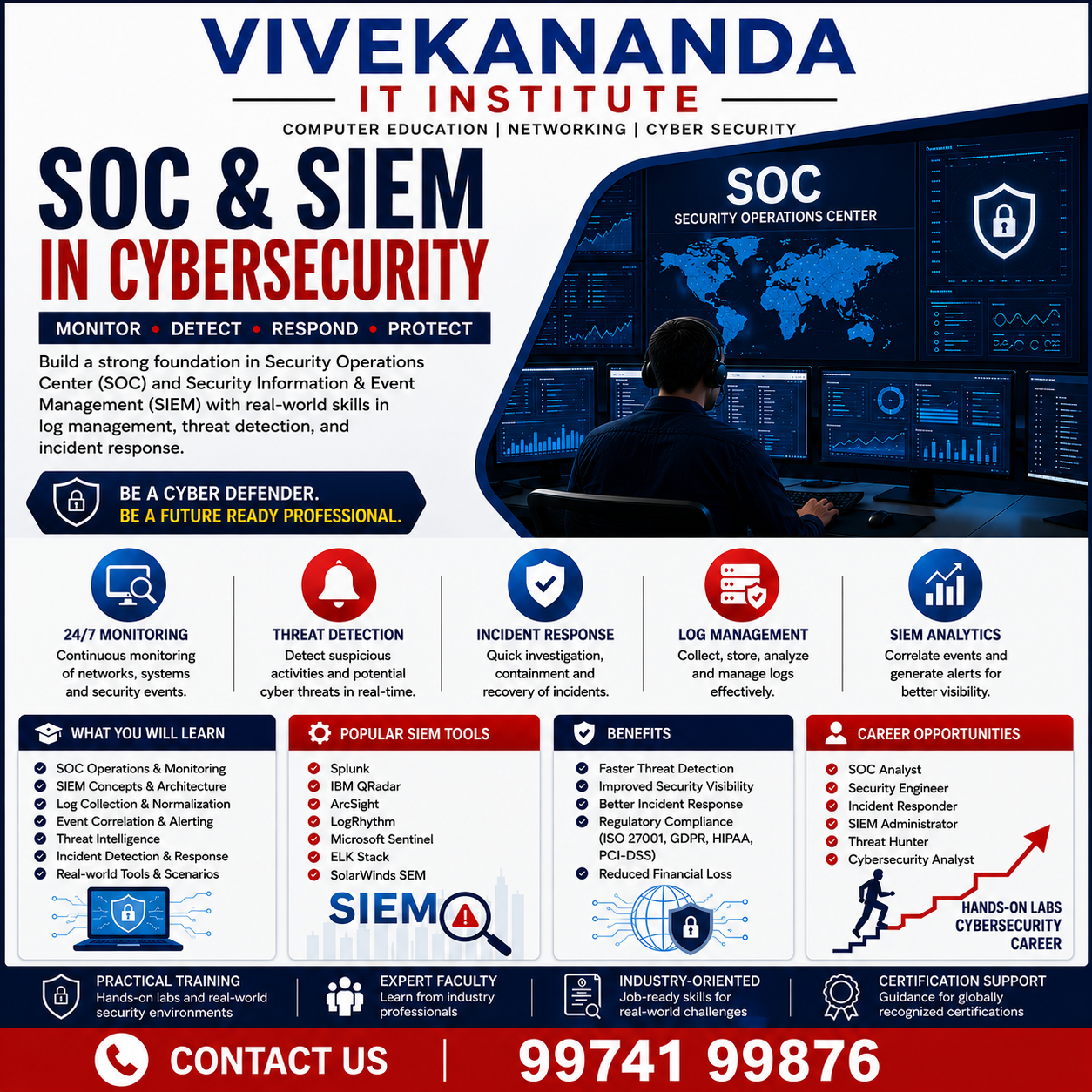
Security Operations Center (SOC) and SIEM
In today’s digital world, cyber threats are becoming more advanced every day. Organizations need powerful security systems that can monitor, detect, and respond to attacks in real time. This is where a Security Operations Center (SOC) and Security Information and Event Management (SIEM) come into action.
At Vivekananda IT Institute, Vadodara, students learning Network and Cybersecurity gain practical knowledge of SOC operations, SIEM tools, log management, and incident response techniques widely used in modern industries.
What is a Security Operations Center (SOC)?
A Security Operations Center (SOC) is a centralized unit where cybersecurity professionals continuously monitor and protect an organization’s networks, systems, servers, and data from cyber threats.
Think of a SOC as the “Cybersecurity Command Center” of an organization.
Just like a city has police control rooms to monitor emergencies, a SOC monitors digital activities and responds instantly to suspicious behavior.
Main Objectives of a SOC
A SOC team works 24/7 to:
- Monitor network traffic
- Detect suspicious activities
- Analyze security alerts
- Prevent cyberattacks
- Investigate incidents
- Respond to threats quickly
- Protect sensitive information
At Vivekananda IT Institute in Vadodara, students are introduced to real-world SOC environments to understand how security analysts defend organizations against cybercrime.
Key Components of a SOC
1. Monitoring Systems
SOC teams use dashboards and monitoring tools to track:
- Network activity
- Firewall logs
- User behavior
- Login attempts
- Server performance
- Malware activity
These systems help identify unusual activities before they become serious attacks.
2. Threat Intelligence
Threat intelligence provides information about:
- Latest malware
- Hacker techniques
- Attack patterns
- Vulnerabilities
SOC analysts use this information to stay ahead of cybercriminals.
3. Incident Response
When a security breach occurs, the SOC team immediately:
- Detects the attack
- Investigates the issue
- Contains the threat
- Removes malicious activity
- Restores normal operations
This process minimizes damage and downtime.
What is SIEM?
SIEM (Security Information and Event Management) is a cybersecurity solution that collects, analyzes, and manages logs and security events from multiple devices and systems.
It acts like a smart surveillance system for networks.
SIEM tools gather data from:
- Firewalls
- Routers
- Servers
- Antivirus systems
- Applications
- Cloud services
- IDS/IPS systems
The SIEM platform then analyzes the data to identify suspicious activities.
How SIEM Works
1. Data Collection
SIEM gathers logs from multiple sources across the network.
Examples:
- Failed login attempts
- File access records
- Firewall traffic logs
- VPN connection logs
2. Log Normalization
Different systems generate logs in different formats.
SIEM converts all logs into a standard format for easier analysis.
3. Event Correlation
SIEM analyzes related events together.
Example:
- Multiple failed login attempts
- Login from an unusual location
- Sudden privilege escalation
The SIEM correlates these events and generates an alert for a possible attack.
4. Alert Generation
If suspicious activity is detected, SIEM creates alerts for SOC analysts to investigate.
Popular SIEM Tools
Students at Vivekananda IT Institute, Vadodara are often introduced to industry-leading SIEM platforms such as:
- Splunk
- IBM QRadar
- ArcSight
- LogRhythm
- Microsoft Sentinel
- ELK Stack
- SolarWinds Security Event Manager
These tools are widely used in enterprises and government organizations.
Log Management in Cybersecurity
What is Log Management?
Log management is the process of:
- Collecting logs
- Storing logs
- Monitoring logs
- Analyzing logs
- Archiving logs securely
Logs provide detailed records of activities happening inside a network.
Why Logs are Important
Logs help organizations:
- Detect attacks
- Investigate incidents
- Monitor user activity
- Troubleshoot problems
- Meet compliance requirements
Without proper log management, cyberattacks may go unnoticed.
Types of Security Logs
1. Firewall Logs
Track incoming and outgoing traffic.
2. Server Logs
Monitor server activities and errors.
3. Authentication Logs
Record successful and failed login attempts.
4. Application Logs
Capture application events and failures.
5. Network Device Logs
Generated by routers, switches, and IDS/IPS systems.
Challenges in Log Management
Organizations generate massive amounts of log data every day.
Common challenges include:
- Huge storage requirements
- Identifying useful information
- Real-time monitoring
- Managing false alerts
- Data privacy concerns
SIEM solutions help overcome these challenges through automation and intelligent analysis.
Incident Detection and Response
What is Incident Detection?
Incident detection is the process of identifying:
- Unauthorized access
- Malware infections
- Data breaches
- Suspicious user behavior
- Network attacks
SOC analysts use SIEM tools and monitoring systems to detect threats early.
What is Incident Response?
Incident response refers to the steps taken after detecting a cyberattack.
The goal is to:
- Stop the attack
- Reduce damage
- Recover systems
- Prevent future incidents
Incident Response Lifecycle
1. Preparation
Organizations prepare by:
- Creating security policies
- Training employees
- Installing monitoring tools
- Building response plans
2. Identification
SOC teams identify suspicious activity using:
- SIEM alerts
- Threat intelligence
- Log analysis
3. Containment
The attack is isolated to prevent further spread.
Examples:
- Disconnecting infected systems
- Blocking malicious IPs
4. Eradication
The root cause is removed.
Examples:
- Deleting malware
- Patching vulnerabilities
5. Recovery
Systems are restored safely.
Activities include:
- Restoring backups
- Monitoring systems
- Verifying security
6. Lessons Learned
After the incident, teams analyze:
- What happened
- How the attack occurred
- How to improve future protection
Real-World Example of SOC and SIEM
Imagine a company employee clicks on a phishing email attachment.
What Happens Next?
- Malware enters the system
- Firewall logs suspicious traffic
- SIEM detects abnormal activity
- SOC analysts receive an alert
- Analysts isolate the infected machine
- Malware is removed
- Systems are restored
This rapid response prevents a major data breach.
Benefits of SOC and SIEM
Faster Threat Detection
Real-time monitoring helps stop attacks quickly.
Improved Security Visibility
Organizations gain complete visibility into network activities.
Better Incident Response
SOC teams can respond efficiently to security incidents.
Regulatory Compliance
Log management supports compliance with standards like:
- ISO 27001
- GDPR
- HIPAA
- PCI-DSS
Reduced Financial Loss
Early detection minimizes operational and financial damage.
Career Opportunities in SOC and SIEM
Cybersecurity professionals with SOC and SIEM expertise are highly in demand worldwide.
Popular job roles include:
- SOC Analyst
- Security Engineer
- Incident Responder
- Threat Hunter
- SIEM Administrator
- Cybersecurity Analyst
At Vivekananda IT Institute, Vadodara, students can develop practical cybersecurity skills through hands-on training and real-world security concepts.
Conclusion
Security Operations Centers (SOC) and SIEM systems are essential pillars of modern cybersecurity. They help organizations monitor networks, manage logs, detect attacks, and respond to incidents effectively.
With the increasing rise of cyber threats, learning SOC operations, SIEM tools, log management, and incident response has become a valuable skill for aspiring cybersecurity professionals.
Vivekananda IT Institute in Vadodara provides students with industry-oriented cybersecurity education, helping them build strong foundations in network security, cyber protection, and security monitoring technologies.