
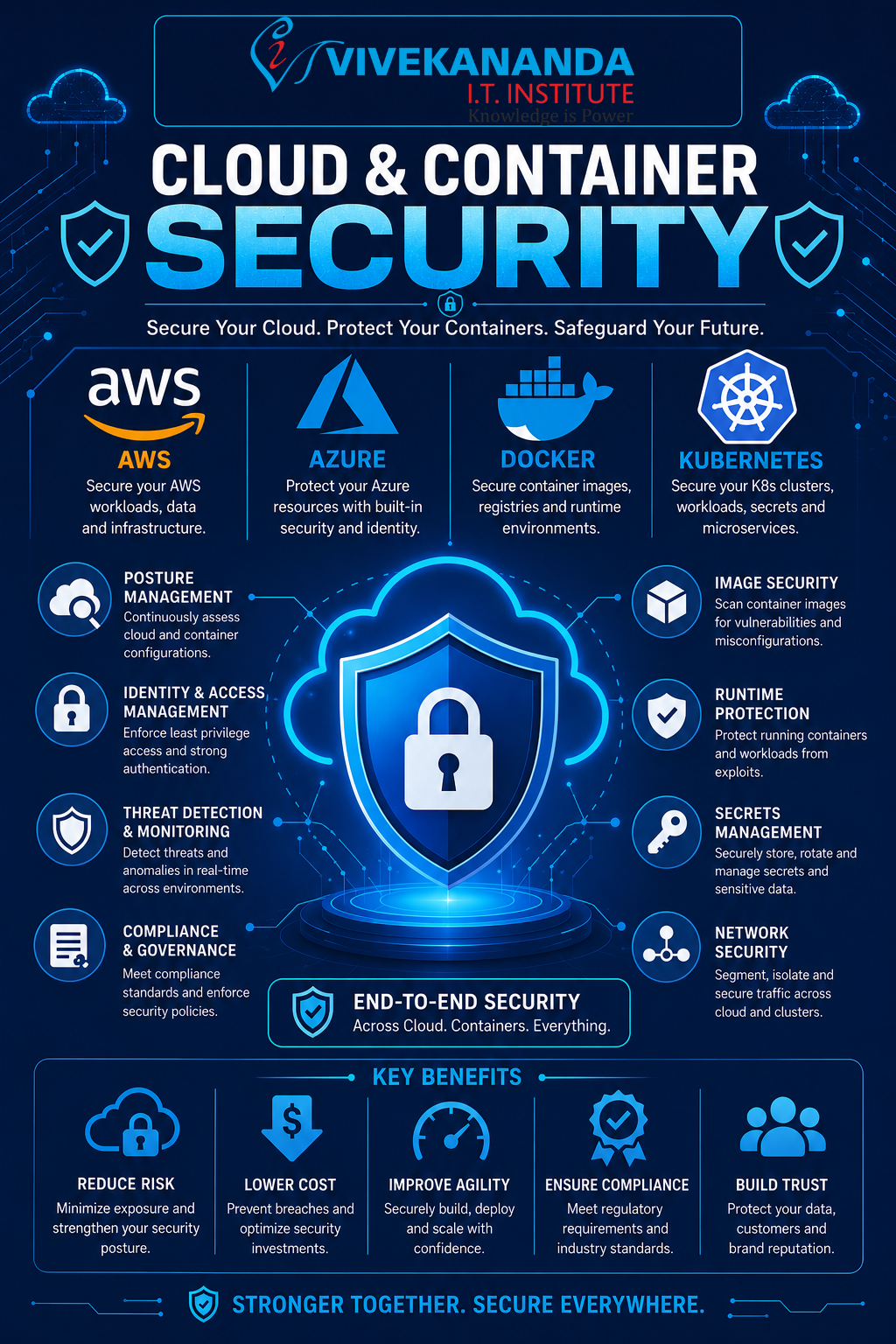
Cloud and Container Security has become one of the most important pillars of modern Network and Cybersecurity. Organizations are rapidly moving from traditional on-premise infrastructure to cloud platforms and containerized environments. While these technologies improve scalability, flexibility, and performance, they also introduce advanced security challenges that require strong protection strategies.
At Vivekananda IT Institute, Vadodara, students are trained not only to understand how cloud and container systems operate, but also how attackers exploit vulnerabilities and how cybersecurity professionals defend enterprise environments against real-world threats.
Cloud Security (AWS & Azure Basics)
Cloud security refers to the technologies, policies, controls, and services used to secure cloud infrastructure, applications, and data from cyber threats.
AWS Security Basics
Amazon Web Services (AWS) follows a Shared Responsibility Model:
- AWS secures the cloud infrastructure
- Customers secure their applications, data, and configurations inside the cloud
Key AWS Security Components
1. IAM (Identity and Access Management)
IAM controls user identities, permissions, and access to cloud resources.
2. Security Groups
Security Groups act as virtual firewalls that regulate inbound and outbound traffic for cloud instances.
3. S3 Bucket Policies
These policies help secure cloud storage and prevent unauthorized public access to sensitive files.
4. CloudTrail
CloudTrail records user activities and API actions for monitoring, auditing, and incident investigation.
5. KMS (Key Management Service)
KMS manages encryption keys used to protect sensitive data stored in AWS services.
Example
If a student deploys a web application on AWS with overly permissive IAM roles, attackers may gain access to databases or administrative resources.
Microsoft Azure Security Basics
Microsoft Azure offers integrated enterprise security tools for monitoring, identity management, and infrastructure protection.
Core Azure Security Features
1. Azure Active Directory (AAD)
Provides authentication, identity management, and secure user access.
2. Network Security Groups (NSG)
NSGs filter and control incoming and outgoing network traffic.
3. Azure Security Center
Offers threat detection, security recommendations, and posture management.
4. Azure Firewall
Protects cloud workloads by filtering malicious traffic and unauthorized connections.
5. Encryption Services
Azure supports encryption for data both at rest and in transit.
Example
A misconfigured Azure storage account may unintentionally expose confidential files to public internet access.
Container Security (Docker & Kubernetes)
Containers allow applications to run consistently across multiple environments. However, improper configuration can create significant cybersecurity risks.
Docker Security
Docker is widely used for building and deploying lightweight application containers.
Important Docker Security Practices
1. Image Scanning
Container images should be scanned regularly to detect vulnerabilities and malware.
2. Least Privilege Principle
Containers should run with minimal permissions to reduce attack impact.
3. Secure Registries
Only trusted and verified container registries should be used.
4. Namespace Isolation
Isolation mechanisms prevent containers from interfering with each other.
5. Read-Only Containers
Using read-only file systems helps prevent unauthorized modifications.
Threat Example
A malicious Docker image downloaded from an untrusted repository may contain hidden malware or backdoors.
Kubernetes Security
Kubernetes is used to manage container clusters at enterprise scale, making security even more critical.
Core Kubernetes Security Layers
1. RBAC (Role-Based Access Control)
RBAC defines permissions for users and services within Kubernetes clusters.
2. Pod Security Policies
Restrict container behavior and reduce privilege escalation risks.
3. Network Policies
Control communication between pods and services.
4. Secrets Management
Protect sensitive credentials such as API keys, passwords, and tokens.
5. API Server Security
Secures the Kubernetes control plane from unauthorized access and attacks.
Threat Example
Improper RBAC configuration can allow attackers to gain administrative control over the entire cluster.
Cloud and Container Security in Cybersecurity Learning
At Vivekananda IT Institute, Vadodara, students gain practical exposure to modern cloud and container security concepts including:
- Cloud infrastructure security
- AWS and Azure security configuration
- Docker vulnerability assessment
- Kubernetes cluster protection
- Threat monitoring and detection
- Defense-in-depth security strategies
- Real-world cyberattack simulations
Career Opportunities
Students can prepare for roles such as:
- Cloud Security Engineer
- SOC Analyst
- DevSecOps Engineer
- Cybersecurity Specialist
- Security Operations Engineer
Real-World Importance
Modern organizations rely heavily on cloud and container platforms for:
- Banking applications
- E-commerce platforms
- Healthcare systems
- Government services
- Enterprise applications
Even a small misconfiguration can result in:
- Data breaches
- Financial losses
- Service outages
- Compliance violations
- Reputation damage
Cloud and container security is now a critical requirement for every organization operating in the digital world.
Conclusion
Cloud and Container Security forms the backbone of modern cybersecurity infrastructure. Understanding AWS, Azure, Docker, and Kubernetes security principles enables professionals to secure cloud-native environments and defend against evolving cyber threats.
Vivekananda IT Institute, Vadodara helps students build practical cybersecurity skills required for modern enterprise security environments and prepares them for successful careers in cloud and cybersecurity domains.