
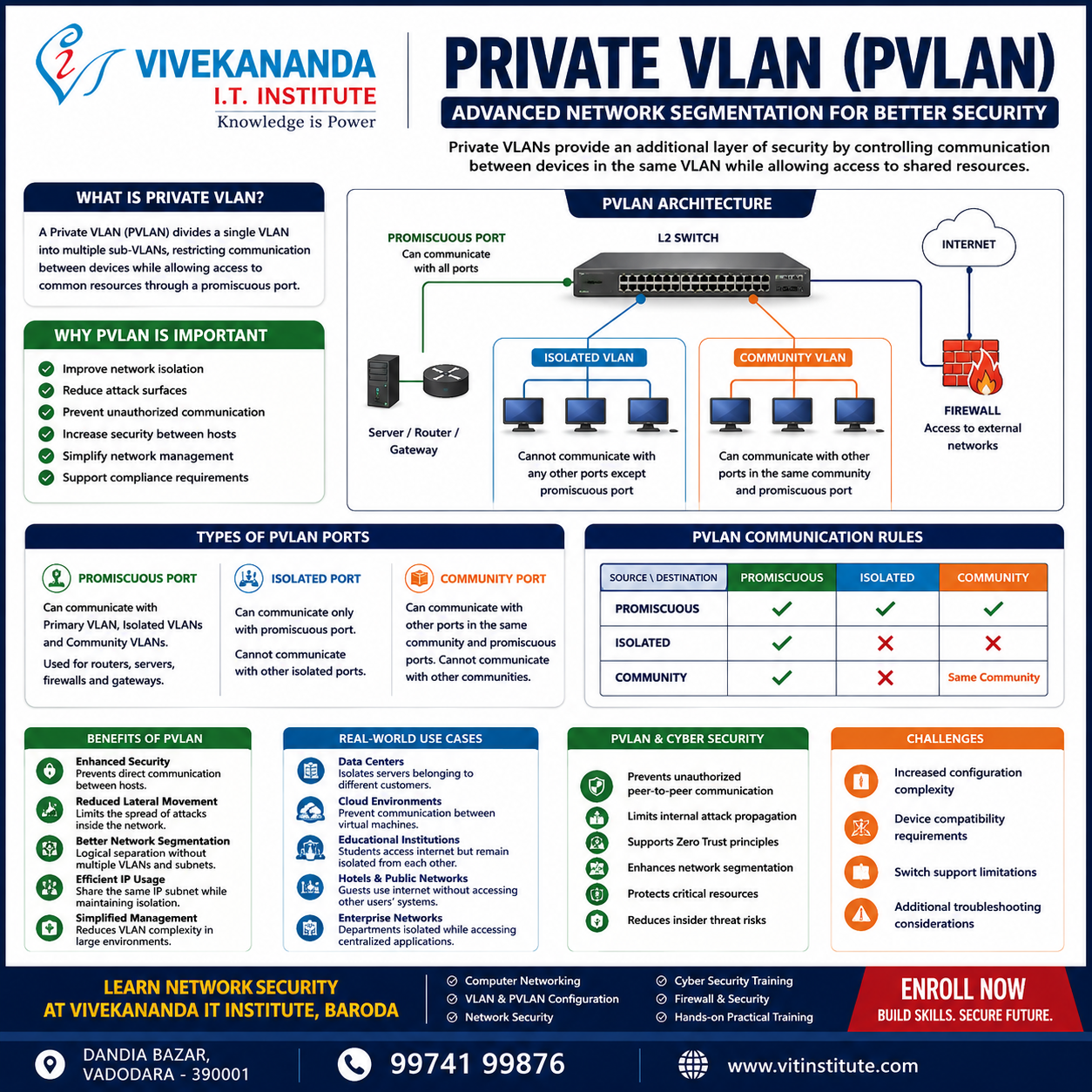
Understanding Private VLAN: Advanced Network Segmentation for Better Security
As organizations continue to expand their network infrastructure, securing internal communication becomes increasingly important. Traditional VLANs help separate network traffic, but they may not always provide sufficient isolation between devices within the same VLAN.
This is where Private VLAN (PVLAN) technology plays a crucial role. Private VLANs provide an additional layer of network segmentation by restricting communication between devices that belong to the same VLAN while still allowing access to shared resources.
At Vivekananda IT Institute, Baroda, students learning networking and cybersecurity gain practical knowledge of advanced network security technologies such as Private VLANs, VLAN segmentation, and secure enterprise network design.
What is a Private VLAN (PVLAN)?
A Private VLAN (PVLAN) is a networking technology that divides a single VLAN into multiple smaller sub-VLANs, providing greater traffic isolation and improved security.
Unlike traditional VLANs, where all devices can communicate freely within the same VLAN, Private VLANs allow administrators to control which devices can communicate with each other.
This approach helps reduce lateral movement inside networks and limits the spread of potential cyber threats.
Why Private VLANs are Important
In many environments such as:
- Data Centers
- Cloud Infrastructure
- Enterprise Networks
- Hosting Providers
- Educational Institutions
Multiple devices may need access to common resources without being allowed to communicate directly with each other.
Private VLANs help:
- Improve network isolation
- Reduce attack surfaces
- Prevent unauthorized communication
- Increase security between hosts
- Simplify network management
- Support compliance requirements
How Private VLAN Works
A Private VLAN consists of:
Primary VLAN
The main VLAN that carries traffic for all associated secondary VLANs.
Secondary VLANs
Subdivisions within the Primary VLAN that control communication between devices.
There are two types of secondary VLANs:
1. Isolated VLAN
Devices connected to an isolated VLAN:
- Cannot communicate with other isolated devices
- Cannot communicate with community VLAN devices
- Can only communicate with the promiscuous port
This provides the highest level of isolation.
2. Community VLAN
Devices within the same community VLAN:
- Can communicate with each other
- Cannot communicate with other community VLANs
- Cannot communicate with isolated VLAN devices
- Can communicate with the promiscuous port
Types of PVLAN Ports
Promiscuous Port
A promiscuous port can communicate with:
- Primary VLAN
- Isolated VLANs
- Community VLANs
Typically assigned to:
- Routers
- Firewalls
- Servers
- Gateways
Isolated Port
An isolated port can communicate only with:
- Promiscuous ports
It cannot communicate with other isolated ports.
Community Port
Community ports can communicate with:
- Other ports in the same community
- Promiscuous ports
They cannot communicate with devices in other communities.
Benefits of Private VLAN
Enhanced Security
Private VLANs prevent direct communication between hosts, reducing the risk of attacks spreading across systems.
Reduced Lateral Movement
If one device becomes compromised, attackers cannot easily move to neighboring devices.
Better Network Segmentation
Organizations can create logical separation without requiring multiple VLANs and subnets.
Efficient IP Address Usage
PVLANs allow multiple isolated groups to share the same IP subnet while maintaining security.
Simplified Data Center Management
Large-scale environments benefit from reduced VLAN complexity and improved traffic control.
Real-World Use Cases of Private VLAN
Data Centers
Servers belonging to different customers can remain isolated while sharing the same network infrastructure.
Cloud Environments
Virtual machines can be prevented from communicating directly with each other.
Educational Institutions
Student systems can access internet services while remaining isolated from one another.
Hotels and Public Networks
Guest devices can connect to the internet without accessing other users’ systems.
Enterprise Networks
Sensitive departments can be isolated while maintaining centralized access to business applications.
Private VLAN and Cyber Security
Private VLANs contribute significantly to cybersecurity by:
- Preventing unauthorized peer-to-peer communication
- Limiting internal attack propagation
- Supporting Zero Trust principles
- Enhancing network segmentation
- Protecting critical resources
- Reducing insider threat risks
Network segmentation remains one of the most effective strategies for strengthening enterprise security.
Challenges of Private VLAN Implementation
While PVLANs offer strong security benefits, administrators should consider:
- Increased configuration complexity
- Device compatibility requirements
- Switch support limitations
- Additional troubleshooting considerations
Proper planning and documentation are essential for successful deployment.
Why Learn Network Security at Vivekananda IT Institute, Baroda?
At Vivekananda IT Institute, Baroda, students gain practical experience in:
- Computer Networking
- VLAN Configuration
- Private VLAN Implementation
- Network Security
- Firewall Technologies
- Cyber Security Fundamentals
- Ethical Hacking
- Network Monitoring
- Enterprise Infrastructure Security
The institute focuses on hands-on learning that prepares students for real-world networking and cybersecurity careers.
Conclusion
Private VLANs provide advanced Layer 2 network segmentation by controlling communication between devices within the same VLAN. They help organizations improve security, reduce lateral movement, protect critical systems, and simplify large-scale network deployments.
As cybersecurity threats continue to evolve, technologies such as Private VLANs play a vital role in building secure and resilient network infrastructures.
Understanding and implementing PVLANs is an essential skill for network administrators, cybersecurity professionals, and IT engineers responsible for protecting modern enterprise environments.