
Transforming Enterprise Networks with Artificial Intelligence
Introduction
Enterprise networks are undergoing a major transformation. The rapid adoption of cloud computing, hybrid workplaces, Internet of Things (IoT), Artificial Intelligence (AI), and Software-Defined Networking (SDN) has significantly increased the complexity of managing modern network infrastructures. Organizations no longer manage a few dozen network devices. Today, it is common to find thousands of switches, routers, wireless access points, firewalls, and cloud-connected devices spread across multiple locations.
Traditional network management methods relied heavily on manual device configuration using the Command Line Interface (CLI). While CLI remains an essential skill for every network engineer, manually configuring hundreds or thousands of devices introduces challenges such as:
- Configuration inconsistencies
- Human errors
- Long deployment times
- Difficulty maintaining security compliance
- Increased operational costs
- Longer Mean Time to Repair (MTTR)
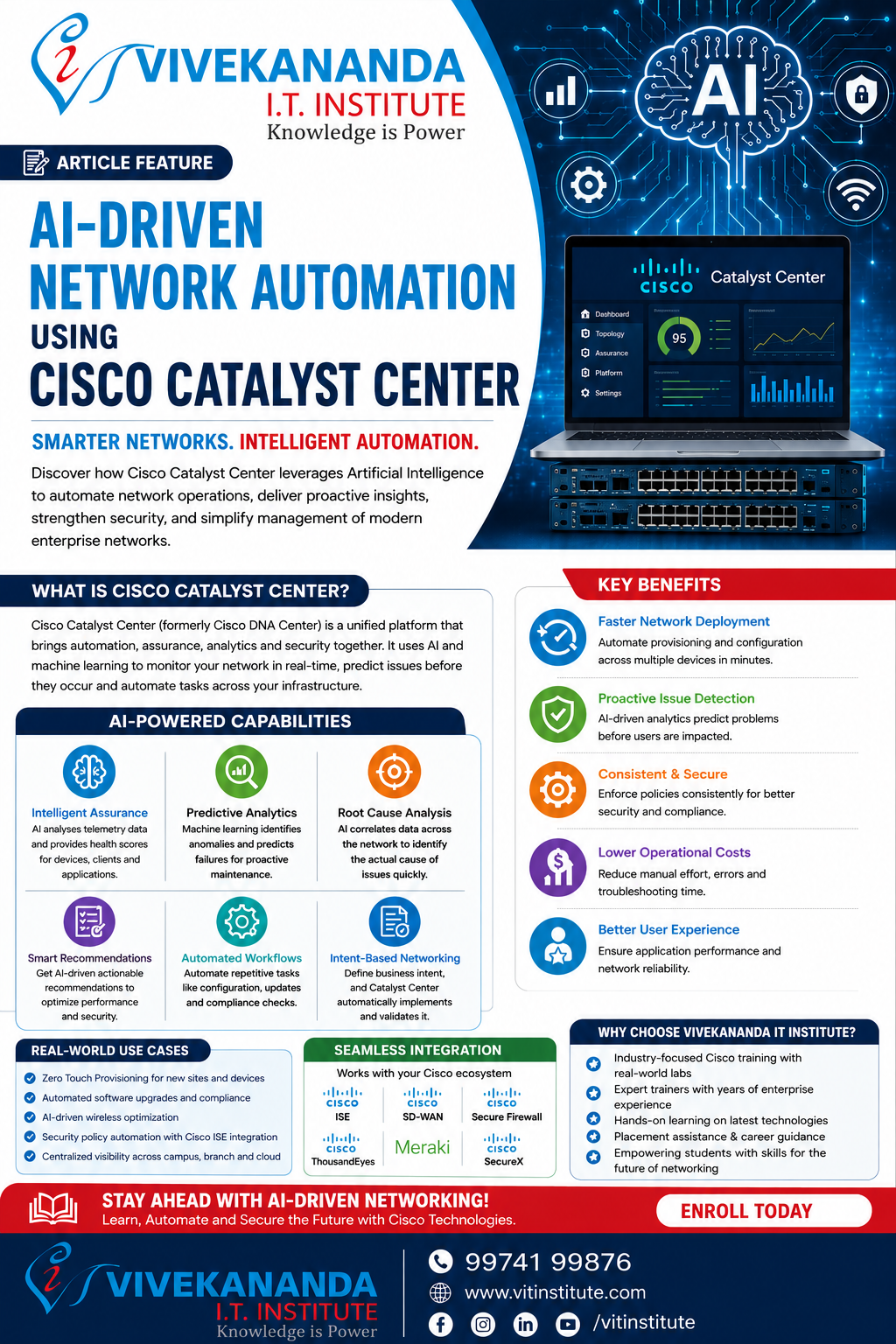
To overcome these challenges, Cisco introduced Cisco Catalyst Center (formerly Cisco DNA Center), an intelligent network management platform that combines automation, AI-powered analytics, policy-based management, and real-time assurance.
This article explores how Cisco Catalyst Center uses Artificial Intelligence to automate enterprise networking, improve operational efficiency, and provide predictive insights that enable organizations to build resilient and intelligent networks.
What is Cisco Catalyst Center?
Cisco Catalyst Center is Cisco’s centralized network management and automation platform designed for enterprise campus, branch, and wireless environments. It provides a single dashboard to manage network devices, automate repetitive tasks, monitor performance, enforce security policies, and gain deep visibility into network health.
Catalyst Center is a key component of Cisco’s Intent-Based Networking (IBN) architecture, where administrators define business objectives instead of manually configuring each device. The platform translates these objectives into automated network policies and continuously validates that the network behaves as intended.
Supported devices include:
- Cisco Catalyst Switches
- Cisco Catalyst Wireless Controllers
- Cisco Access Points
- Cisco ISR and ASR Routers
- Cisco SD-Access Fabrics
- Cisco Identity Services Engine (ISE)
- Cisco Secure Firewall (through integrations)
By centralizing management and leveraging AI, Catalyst Center simplifies network operations while improving security and reliability.
Why AI is Essential in Modern Networking
Enterprise networks generate massive amounts of operational data every second. Devices continuously report telemetry information such as CPU utilization, memory usage, interface statistics, wireless signal strength, client connectivity, application performance, and security events.
Manually analyzing this information is practically impossible. Artificial Intelligence and Machine Learning address this challenge by processing large volumes of telemetry data, identifying trends, detecting anomalies, and recommending corrective actions.
AI-powered networking enables administrators to move from reactive troubleshooting to proactive network management. Instead of waiting for users to report slow applications or connectivity problems, the platform identifies potential issues before they impact business operations.
Evolution of Network Management
Traditional Network Management
Historically, network administrators performed tasks manually:
- Device configuration using CLI
- Firmware upgrades
- VLAN creation
- Interface configuration
- Troubleshooting through log analysis
- Manual backup of configurations
Although effective for smaller networks, these methods become increasingly difficult to scale.
AI-Driven Network Management
Modern AI-driven platforms automate these processes by:
- Discovering devices automatically
- Deploying standardized configurations
- Monitoring network health continuously
- Predicting hardware failures
- Detecting abnormal traffic patterns
- Providing intelligent recommendations
- Automating software upgrades
This significantly reduces administrative effort while improving network consistency.
Key Components of Cisco Catalyst Center
Network Discovery
Catalyst Center automatically discovers network devices using protocols such as:
- CDP
- LLDP
- SNMP
- SSH
- ICMP
Once discovered, devices are added to the inventory with detailed information including hardware models, software versions, serial numbers, interface status, and licensing.
Inventory Management
The inventory module provides complete visibility into enterprise infrastructure.
Administrators can view:
- Device models
- IOS versions
- Uptime
- Interface utilization
- Hardware health
- Software compliance
- Warranty information
This centralized inventory simplifies lifecycle management and capacity planning.
Configuration Automation
One of the most valuable capabilities of Catalyst Center is configuration automation.
Instead of configuring each switch individually, administrators create reusable templates that define:
- VLAN configuration
- Interface settings
- Routing protocols
- NTP
- SNMP
- Syslog
- AAA
- Security policies
- QoS
These templates can be applied consistently across hundreds or thousands of devices, reducing configuration errors and ensuring standardization.
AI-Powered Network Assurance
Cisco Catalyst Center continuously collects telemetry from network devices to assess overall network health.
AI-driven assurance evaluates:
- Device Health
- Client Health
- Application Health
- Wireless Performance
- Network Availability
The platform assigns health scores that help administrators quickly identify areas requiring attention.
For example, if wireless clients experience authentication failures due to a RADIUS server issue, Catalyst Center correlates events across multiple devices and highlights the root cause instead of presenting isolated alerts.
Machine Learning for Predictive Analytics
Machine Learning enables Catalyst Center to recognize normal network behavior and identify deviations.
Examples include:
- Increasing interface errors
- Rising CPU utilization
- Wireless interference
- Abnormal latency
- Packet loss
- Device instability
- Authentication failures
Rather than simply reporting these issues, AI predicts potential failures before they occur, allowing administrators to take preventive action.
Predictive maintenance significantly improves network availability and reduces unexpected downtime.
Intelligent Root Cause Analysis
Traditional troubleshooting often requires administrators to examine logs from multiple devices.
Catalyst Center simplifies this process by correlating information collected from switches, routers, wireless controllers, and clients.
Possible root causes include:
- DHCP failures
- DNS latency
- Authentication problems
- Faulty switch ports
- Wireless roaming issues
- High CPU utilization
- Network congestion
- Application delays
AI reduces troubleshooting time by identifying the most probable source of the problem.
Intent-Based Networking
Intent-Based Networking (IBN) represents a major advancement in enterprise networking.
Instead of manually configuring devices, administrators define business intent.
For example:
“Employees in the Finance department should access ERP servers but should not access Guest Wi-Fi resources.”
Catalyst Center automatically converts this policy into network configurations across switches, wireless controllers, and security devices.
The workflow consists of:
- Define business intent.
- Translate intent into network policies.
- Deploy configurations automatically.
- Validate compliance.
- Monitor network behavior continuously.
This approach improves consistency while reducing administrative effort.
AI-Driven Automation Workflow
A typical automation process within Catalyst Center includes:
Device Discovery
New devices are detected automatically.
Software Validation
Device software versions are checked against organizational standards.
Configuration Deployment
Templates are applied automatically.
Policy Enforcement
Security and network policies are implemented consistently.
Continuous Monitoring
Real-time telemetry is analyzed continuously.
Optimization
AI recommends configuration improvements based on observed behavior.
Integration with Cisco Technologies
Catalyst Center integrates seamlessly with Cisco’s enterprise ecosystem.
Cisco Identity Services Engine (ISE)
Provides identity-based access control and dynamic policy enforcement.
Cisco ThousandEyes
Offers end-to-end visibility into Internet and cloud application performance.
Cisco Secure Firewall
Supports centralized security policy integration.
Cisco SD-WAN
Simplifies WAN deployment and management.
Cisco Meraki
Extends visibility across cloud-managed branch networks.
Cisco SecureX
Provides unified security operations and threat response.
Real-World Enterprise Scenario
Consider a company with:
- 75 branch offices
- 2 data centers
- 500 Cisco switches
- 120 wireless access points
- Thousands of connected users
Without automation:
- Every switch requires manual configuration.
- Software upgrades consume weeks.
- Security policies are applied inconsistently.
- Troubleshooting requires multiple tools.
Using Cisco Catalyst Center:
- New switches receive automatic configurations through Plug and Play.
- Firmware upgrades are scheduled centrally.
- AI continuously monitors network performance.
- Health scores identify issues before users notice them.
- Policy changes are deployed across the entire organization within minutes.
The result is improved operational efficiency, reduced downtime, and a better user experience.
Benefits of AI-Driven Network Automation
Organizations implementing Cisco Catalyst Center gain several advantages:
- Faster deployment of enterprise networks
- Reduced configuration errors
- Improved network reliability
- Consistent security policies
- Lower operational costs
- Faster troubleshooting
- Better compliance management
- Simplified software lifecycle management
- Enhanced user experience
- Improved network visibility
Challenges and Considerations
While AI-driven automation offers significant benefits, organizations should consider:
- Initial deployment planning
- Staff training and skill development
- Integration with legacy infrastructure
- Telemetry data quality
- Licensing requirements
- Change management processes
- Security and compliance requirements
A phased implementation strategy helps maximize the return on investment.
Future of AI-Driven Networking
Enterprise networking is moving toward autonomous operations.
Future capabilities are expected to include:
- Self-healing networks
- AI-generated configuration templates
- Predictive capacity planning
- Digital twin network simulations
- Natural language network administration
- AI-assisted cybersecurity
- Automated compliance verification
- Intelligent network optimization
As AI technologies continue to mature, network administrators will increasingly focus on strategic planning while routine operational tasks become automated.
Learning Cisco Network Automation
For networking professionals, understanding AI-driven automation is becoming as important as learning routing and switching. Skills in Cisco Catalyst Center, Python, APIs, Ansible, RESTCONF, NETCONF, and Intent-Based Networking are highly valued in enterprise IT environments.
Training institutions that emphasize practical labs and real-world enterprise scenarios help learners build the expertise required to implement and manage automated networks. Vivekananda IT Institute focuses on hands-on learning in Cisco Enterprise Networking, network automation, cybersecurity, and emerging technologies, enabling students and IT professionals to develop industry-ready skills aligned with modern enterprise requirements.
Conclusion
AI-driven network automation is reshaping the way enterprise networks are designed, deployed, and managed. Cisco Catalyst Center combines centralized management, intelligent automation, AI-powered analytics, and policy-based networking into a comprehensive platform that simplifies operations while improving reliability and security.
By leveraging Artificial Intelligence, Machine Learning, and Intent-Based Networking, organizations can automate repetitive tasks, detect issues proactively, enforce consistent policies, and deliver exceptional user experiences. As enterprise networks continue to grow in scale and complexity, AI-driven automation will play a central role in building resilient, secure, and future-ready digital infrastructures.
About Vivekananda IT Institute
Vivekananda IT Institute is committed to delivering practical, industry-oriented training in Cisco Enterprise Networking, Network Security, Ethical Hacking, VAPT, Cloud Computing, Firewall Technologies, and Network Automation. Through hands-on labs, real-world case studies, and expert-led instruction, the institute equips students and working professionals with the skills needed to succeed in today’s rapidly evolving IT industry. As AI-driven networking becomes the new standard, continuous learning and practical experience remain the foundation of a successful networking career.