
The Foundation of Modern Network Security
Introduction
The traditional approach to network security relied on the principle of “Trust but Verify.” Once users or devices entered the corporate network, they were often granted broad access to applications, servers, and data. This model worked well when employees primarily worked from office locations and most IT resources resided within a centralized data center.
Today, enterprise IT environments have evolved significantly. Organizations now support hybrid workforces, cloud computing, Software-as-a-Service (SaaS) applications, Internet of Things (IoT) devices, and remote access from multiple locations. As a result, the traditional perimeter-based security model is no longer sufficient.
Cybercriminals increasingly exploit stolen credentials, insider threats, ransomware, and compromised devices to move laterally within networks. To address these evolving threats, organizations are adopting Zero Trust Network Architecture (ZTNA), a security model based on the principle of “Never Trust, Always Verify.”
Rather than assuming that users or devices inside the network are trustworthy, Zero Trust continuously verifies identity, device health, location, and access permissions before granting access to resources.
This article explores the principles, architecture, technologies, implementation strategies, benefits, challenges, and future of Zero Trust Network Architecture.
What is Zero Trust Network Architecture?
Zero Trust Network Architecture (ZTNA) is a cybersecurity framework that assumes no user, device, or application should be trusted by default, regardless of whether they are inside or outside the organization’s network.
Every access request must be:
- Authenticated
- Authorized
- Continuously validated
- Monitored
The objective is to minimize unauthorized access and reduce the impact of cyberattacks.
Why Traditional Security Models Are No Longer Enough
Traditional network security focused on protecting the network perimeter using:
- Firewalls
- VPNs
- Intrusion Prevention Systems
- Access Control Lists
Once users authenticated to the network, they often had unrestricted access to multiple systems.
This creates several risks:
- Stolen credentials
- Insider threats
- Lateral movement by attackers
- Ransomware spreading across networks
- Compromised IoT devices
- Excessive user privileges
Zero Trust addresses these risks by verifying every request, regardless of its origin.
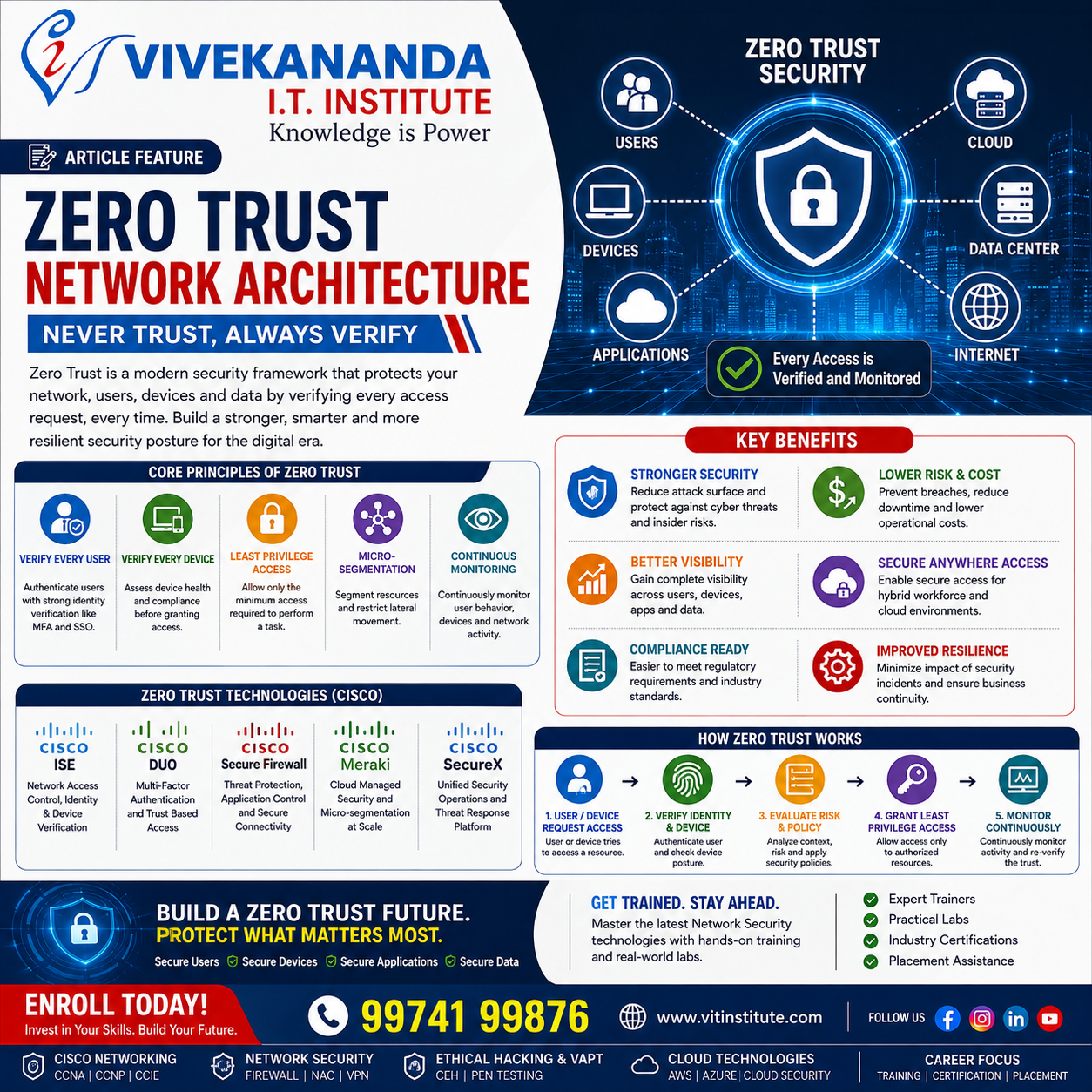
Core Principles of Zero Trust
1. Verify Every User
Every user must be authenticated before accessing network resources.
Methods include:
- Multi-Factor Authentication (MFA)
- Single Sign-On (SSO)
- Identity Providers (IdP)
- Biometric Authentication
2. Verify Every Device
Access decisions should consider device posture.
Examples:
- Operating system version
- Antivirus status
- Endpoint Detection and Response (EDR)
- Disk encryption
- Security patches
- Device compliance
3. Least Privilege Access
Users should receive only the minimum permissions required to perform their tasks.
Benefits include:
- Reduced attack surface
- Prevention of privilege abuse
- Limited impact of compromised accounts
4. Micro-Segmentation
Networks should be divided into smaller secure segments.
Examples:
- Finance
- HR
- Guest Wi-Fi
- Servers
- Development
- Production
Even if attackers compromise one segment, they cannot easily move to another.
5. Continuous Monitoring
Security systems continuously monitor:
- User behavior
- Device activity
- Login attempts
- Network traffic
- Application access
- Threat intelligence
Suspicious activities trigger alerts or automatic access restrictions.
Components of Zero Trust Architecture
A Zero Trust implementation typically includes:
Identity Management
- Active Directory
- Azure AD
- Cisco Duo
- Okta
Multi-Factor Authentication
Verifies user identity using:
- Password
- Mobile authentication
- Hardware tokens
- Biometrics
Network Access Control (NAC)
Solutions like Cisco Identity Services Engine (ISE) verify users and devices before granting network access.
Endpoint Security
Protects devices using:
- Antivirus
- EDR
- XDR
- Patch management
Firewalls
Next-Generation Firewalls inspect application traffic and enforce security policies.
Example:
- Cisco Secure Firewall
Security Information and Event Management (SIEM)
Collects and analyzes security logs from multiple systems.
Examples:
- Splunk
- Microsoft Sentinel
- IBM QRadar
Zero Trust Architecture Workflow
A typical access request follows these steps:
Step 1
User attempts to access an application.
Step 2
Identity is verified using MFA.
Step 3
Device posture is checked.
Step 4
Risk score is calculated.
Step 5
Access policies are evaluated.
Step 6
Least privilege access is granted.
Step 7
User activity is continuously monitored.
If suspicious activity is detected, access can be restricted automatically.
Cisco Technologies Supporting Zero Trust
Cisco provides several solutions for implementing Zero Trust.
Cisco Identity Services Engine (ISE)
Provides:
- Identity-based access control
- Device authentication
- Network segmentation
- Guest access management
Cisco Duo
Provides:
- Multi-Factor Authentication
- Device trust
- Risk-based authentication
- Passwordless authentication
Cisco Secure Firewall
Enforces:
- Application visibility
- User-based policies
- Threat prevention
- Malware protection
Cisco Secure Endpoint
Protects endpoints through:
- Malware detection
- Behavioral analysis
- Threat intelligence
Cisco SecureX
Integrates security tools into a unified platform for faster detection and response.
Real-World Example
A financial institution has:
- Head Office
- 30 Branch Offices
- Remote Employees
- Cloud Applications
Without Zero Trust:
A compromised employee laptop could allow attackers to move laterally and access sensitive financial systems.
With Zero Trust:
- MFA verifies user identity.
- Device health is checked.
- Cisco ISE validates network access.
- Cisco Secure Firewall enforces policies.
- Finance systems remain isolated through micro-segmentation.
- Cisco SecureX monitors suspicious activity.
Even if credentials are stolen, attackers cannot easily access critical systems.
Benefits of Zero Trust
Organizations adopting Zero Trust gain:
- Stronger protection against ransomware
- Reduced insider threats
- Better regulatory compliance
- Improved visibility into user activity
- Secure remote access
- Enhanced cloud security
- Reduced attack surface
- Better protection of sensitive data
- Simplified security policy enforcement
- Greater business resilience
Challenges
Organizations should also consider:
- Legacy system compatibility
- Initial deployment costs
- User training
- Policy design complexity
- Integration with existing infrastructure
- Continuous monitoring requirements
A phased implementation strategy helps overcome these challenges.
Best Practices for Implementing Zero Trust
- Inventory all users, devices, and applications.
- Implement Multi-Factor Authentication across the organization.
- Enforce least privilege access.
- Deploy Network Access Control solutions.
- Segment critical business applications.
- Continuously monitor network activity.
- Keep systems updated with the latest security patches.
- Integrate SIEM and XDR platforms for centralized visibility.
- Conduct regular security assessments and penetration testing.
- Train employees on cybersecurity awareness.
Future of Zero Trust
Zero Trust continues to evolve with:
- AI-driven access decisions
- Behavioral analytics
- Passwordless authentication
- Continuous risk assessment
- Identity-first security
- Secure Access Service Edge (SASE)
- Cloud-native security
- Integration with AI-powered Security Operations Centers (SOC)
As organizations increasingly adopt cloud services and hybrid work models, Zero Trust is expected to become the standard approach to enterprise security.
Learning Zero Trust Security
Modern cybersecurity professionals should develop expertise in:
- Cisco ISE
- Cisco Secure Firewall
- Cisco Duo
- Network Access Control
- Firewall Technologies
- SIEM
- XDR
- Network Segmentation
- Cloud Security
- Identity and Access Management (IAM)
At Vivekananda IT Institute, students gain practical experience through hands-on labs covering Cisco Enterprise Networking, Network Security, Ethical Hacking, VAPT, Firewall Technologies, Cloud Security, and Zero Trust implementation. The training focuses on real-world enterprise scenarios, preparing learners for careers in networking and cybersecurity.
Conclusion
Zero Trust Network Architecture is redefining enterprise security by replacing implicit trust with continuous verification. Through identity-based access, device validation, micro-segmentation, least privilege, and continuous monitoring, organizations can significantly reduce cyber risks while supporting modern hybrid work environments.
With Cisco solutions such as Cisco ISE, Cisco Duo, Cisco Secure Firewall, and Cisco SecureX, businesses can build a secure, scalable, and resilient Zero Trust framework that protects users, applications, and data against evolving cyber threats.