
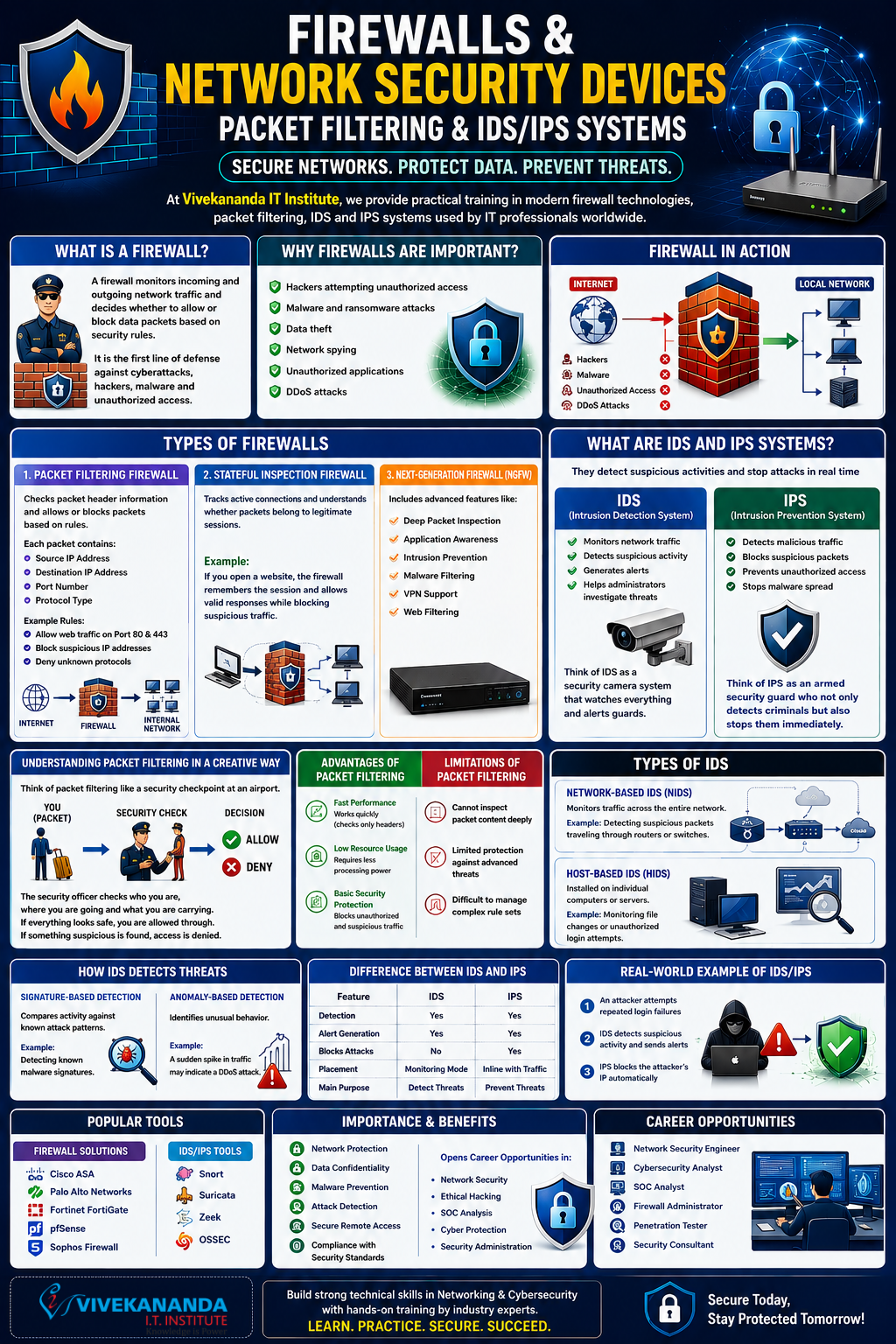
- Firewalls and Network Security Devices:
The Digital Security Guards of Modern Networks
In today’s digital world, cyber threats are growing faster than ever. Every organization, from small businesses to multinational companies, depends on secure computer networks to protect sensitive data and maintain smooth operations. This is where Firewalls and Network Security Devices play a critical role.
At Vivekananda IT Institute, students learning Networking and Cybersecurity gain practical knowledge of modern security technologies used by IT professionals worldwide. If you want to build a successful career in cybersecurity, understanding firewalls, packet filtering, and IDS/IPS systems is essential.
- What is a Firewall?
Imagine a firewall as a security guard standing at the entrance of a building. Every person entering or leaving is checked based on security rules. Similarly, a firewall monitors incoming and outgoing network traffic and decides whether to allow or block data packets.
A firewall acts as the first line of security against cyberattacks, hackers, malware, and unauthorized access.
- Why Firewalls Are Important?
- Without firewalls, networks become vulnerable to:
- Hackers attempting unauthorized access
- Malware and ransomware attacks
- Data theft
- Network spying
- Unauthorized applications
- Dodos attacks
At Vivekananda IT Institute, students learn how organizations use advanced firewalls to secure their infrastructure and protect confidential information.
- Types of Firewalls
1. Packet Filtering Firewall
Packet filtering is one of the oldest and simplest firewall technologies.
- How Packet Filtering Works?
A network communicates using small units called packets.
- Each packet contains information such as:
- Source IP address
- Destination IP address
- Port number
- Protocol type
A packet filtering firewall checks these details and applies predefined security rules.
- For example:
- Allow web traffic on Port 80 and 443
- Block suspicious IP addresses
- Deny unknown protocols
If the packet matches the rule, it is allowed. Otherwise, it is blocked.
- Understanding Packet Filtering in a Creative Way
Think of packet filtering like a security checkpoint at an airport.
The security officer checks:
- Who you are
- Where you are going
- What you are carrying
If everything looks safe, you are allowed through. If something suspicious is found, access is denied.
Similarly, packet filtering firewalls inspect every data packet entering the network.
Advantages of Packet Filtering
- Fast Performance
Packet filtering works quickly because it checks only packet headers.
- Low Resource Usage
It requires less processing power compared to advanced firewalls.
- Basic Security Protection
It blocks unauthorized traffic and suspicious connections.
Limitations of Packet Filtering
- Although useful, packet filtering has some limitations:
- Cannot inspect packet content deeply
- Limited protection against advanced cyber threats
- Difficult to manage complex rule sets
This is why modern organizations combine packet filtering with advanced security devices.
Persistence Inspection Firewall
A persistence firewall is smarter than a simple packet filter.
It tracks active connections and understands whether packets belong to legitimate sessions.
- Example:
If you open a website, the firewall remembers the session and allows valid responses while blocking suspicious traffic.
- Next-Generation Firewall (NGFW)
- Modern businesses use Next-Generation Firewalls that include:
- Deep packet inspection
- Application awareness
- Intrusion prevention
- Malware filtering
- VPN support
- Web filtering
Students at Vivekananda IT Institute gain exposure to real-world cybersecurity technologies used in enterprise environments.
- What are IDS and IPS Systems?
Cybersecurity is not only about blocking traffic. Networks must also detect suspicious activities and stop attacks in real time.
This is where:
- IDS (Intrusion Detection System)
- IPS (Intrusion Prevention System)
becomes extremely important.
- Intrusion Detection System (IDS)
An IDS monitors network traffic and detects suspicious or malicious activity.
- What IDS Does?
- Monitors network conduct
- Detects cyberattacks
- Generates alerts
- Helps administrators investigate threats
Think of IDS as a security camera system that watches everything and alerts guards if suspicious activity occurs.
- Types of IDS
Network-Based IDS (NIDS)
Monitors traffic across the entire network.
- Example:
Detecting suspicious packets traveling through routers or switches.
Host-Based IDS (HIDS)
Installed on individual computers or servers.
- Example:
Monitoring file changes or unauthorized login attempts.
- How IDS Detects Threats
- IDS systems use several detection techniques:
Signature-Based Detection
Compares activity against known attack patterns.
- Example:
Detecting known malware signatures.
Anomaly-Based Detection
Identifies unusual conduct.
- Example:
A sudden spike in traffic may indicate a DDoS attack.
- Intrusion Prevention System (IPS)
An IPS goes one step further than IDS.
While IDS only detects and alerts, IPS can automatically stop attacks.
IPS Functions
- Detect malicious traffic
- Block suspicious packets
- Prevent unauthorized access
- Stop malware spread
Think of IPS as an armed security guard who not only detects criminals but also stops them immediately.
- Difference Between IDS and IPS
| Feature | IDS | IPS |
| Detection | Yes | Yes |
| Alert Generation | Yes | Yes |
| Blocks Attacks | No | Yes |
| Placement | Monitoring mode | Inline with traffic |
| Main Purpose | Detect threats | Prevent threats |
- Real-World Example of IDS/IPS
- Imagine a company network in Vadodara:
- An attacker attempts repeated login failures
- IDS detects suspicious conduct and sends alerts
- IPS blocks the attacker’s IP automatically
This prevents data breaches and protects the organization’s systems.
At Vivekananda IT Institute, students learn how to configure IDS/IPS tools used in real cybersecurity environments.
- Popular Firewall and IDS/IPS Tools
- Firewall Solutions
- Cisco ASA
- Palo Alto Networks
- Fortinet Forty Gate
- PF Sense
- Sophos Firewall
- IDS/IPS Tools
- Snort
- Surakarta
- Zees
- OSSEC
These tools are widely used in the cybersecurity industry.
- Importance of Firewalls and IDS/IPS in Cybersecurity
Modern organizations rely heavily on security devices because cyber threats continue evolving.
- Benefits include:
- Network protection
- Data confidentiality
- Malware prevention
- Attack detection
- Secure remote access
- Compliance with security standards
Learning these technologies opens career opportunities in:
- Network Security
- Ethical Hacking
- SOC Analysis
- Cyber protection
- Security Administration
- Career Opportunities in Network Security
Students trained in firewall technologies and IDS/IPS systems can pursue roles such as:
- Network Security Engineer
- Cybersecurity Analyst
- SOC Analyst
- Firewall Administrator
- Penetration Tester
- Security Consultant
At Vivekananda IT Institute, aspiring cybersecurity professionals receive industry-focused training designed to meet current market demands.
- Conclusion
Firewalls and network security devices are the backbone of modern cybersecurity. From simple packet filtering to advanced IDS/IPS systems, these technologies help organizations defend against cyber threats and maintain secure communication.
Understanding how these systems work is essential for anyone pursuing a career in networking and cybersecurity. With practical training and hands-on learning at Vivekananda IT Institute, students in Vadodara can build strong technical skills and prepare for successful careers in the rapidly growing cybersecurity industry.