
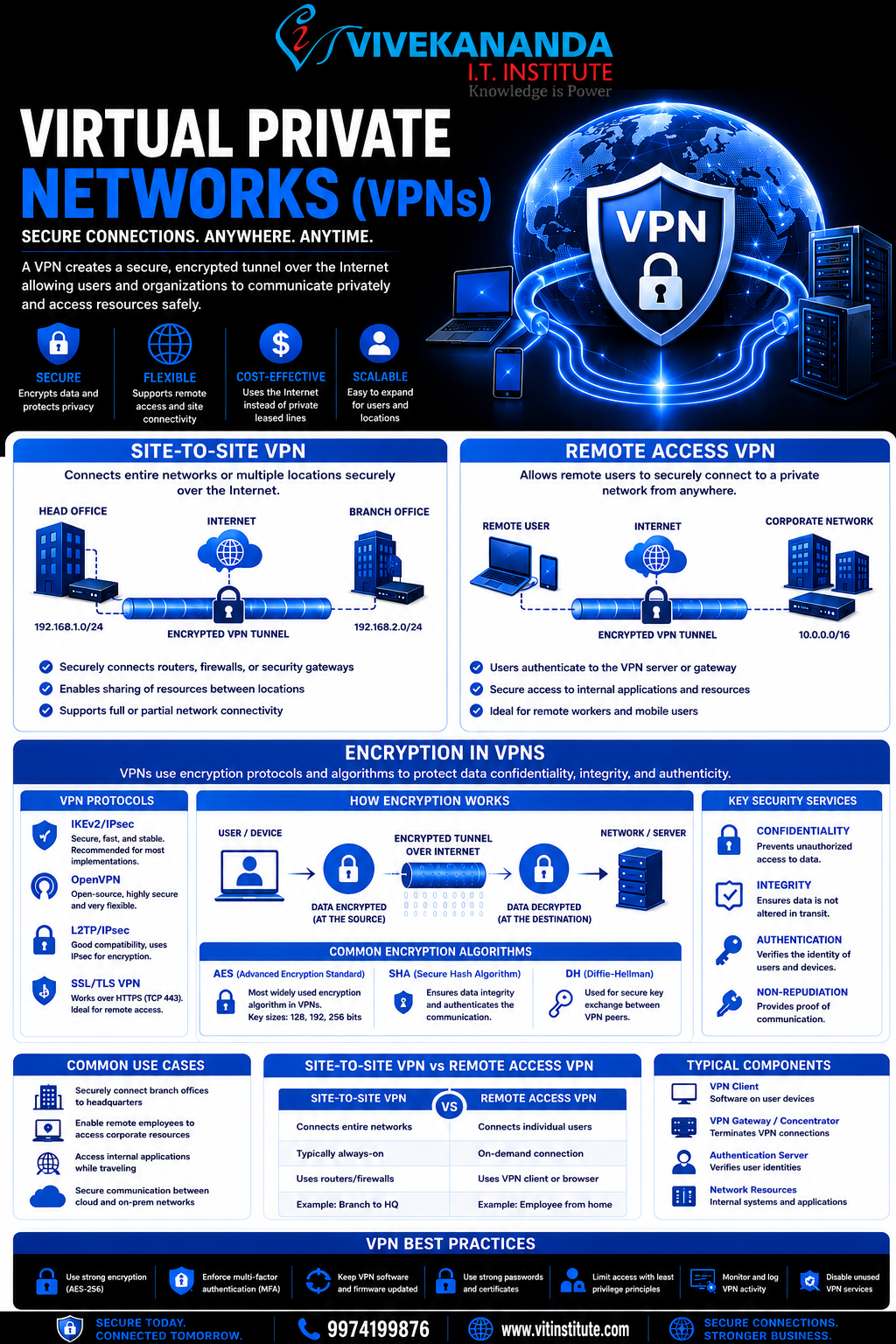
Site-to-Site and Remote-Access VPNs | Encryption in VPNs
Virtual Private Networks (VPNs): Building Secure Digital Highways
Imagine sending a confidential letter across a crowded city. Would you send it openly for anyone to read? Of course not. You would seal it in an envelope and perhaps even use a trusted courier.
In the digital world, VPNs (Virtual Private Networks) play that exact role. They create a secure, encrypted tunnel for your data to travel safely across the internet.
At Vivekananda IT Institute, Vadodara, students learn how VPNs form the backbone of secure communication in modern networking and cybersecurity environments.
What is a VPN?
A VPN (Virtual Private Network) is a technology that allows users to create a secure connection over an unsecured network like the internet. It hides your IP address, encrypts your data, and ensures privacy while accessing resources remotely.
Think of it as:
A private tunnel inside a busy highway where only authorized users can travel safely.
Types of VPNs
1. Site-to-Site VPN
A Site-to-Site VPN connects entire networks, such as branch offices, to each other securely over the internet.
How It Works
- Two or more office networks are connected securely
- Routers or firewalls handle encryption and decryption
- Employees do not need individual VPN setups
Real-Life Example
A company in Mumbai securely connects its branch office in Vadodara using a Site-to-Site VPN so employees can access shared files and systems safely.
Key Benefits
- Seamless office-to-office communication
- Cost-effective alternative to leased lines
- Centralized network security
2. Remote-Access VPN
A Remote-Access VPN allows individual users to connect securely to a private network from anywhere.
How It Works
- Users install VPN software on their device
- They log in using secure credentials
- A secure tunnel is created between the user and the company network
Real-Life Example
A student from Vivekananda IT Institute, Vadodara securely accesses lab resources from home using a Remote-Access VPN.
Key Benefits
- Work or study securely from anywhere
- Protects sensitive data on public Wi-Fi
- Flexible and scalable solution
Encryption in VPNs: The Secret Code
Encryption is the heart of VPN security. It ensures that even if someone intercepts your data, they cannot understand it.
How Encryption Works
- Data is converted into unreadable code called ciphertext
- Only authorized users with the correct key can decrypt it
- Common VPN protocols ensure strong encryption and secure communication
Common VPN Encryption Protocols
1. IPsec (Internet Protocol Security)
- Provides strong encryption and authentication
- Commonly used in Site-to-Site VPNs
- Works at the network layer
2. SSL/TLS (Secure Sockets Layer / Transport Layer Security)
- Commonly used in Remote-Access VPNs
- Operates through web browsers
- Easy for users with minimal setup requirements
3. OpenVPN
- Open-source and highly secure
- Flexible and widely used across industries
- Supports multiple encryption algorithms
Why VPNs Matter in Cybersecurity
At Vivekananda IT Institute, Vadodara, students learn that VPNs are not just networking tools. They are essential cybersecurity solutions that protect organizations and users from modern digital threats.
Protection Against
- Data interception and Man-in-the-Middle attacks
- Unauthorized network access
- Identity tracking and surveillance
VPNs Ensure
- Confidentiality
- Data integrity
- Secure remote access
Learning VPNs at Vivekananda IT Institute, Vadodara
Students at Vivekananda IT Institute, Vadodara gain practical, hands-on experience with:
- Configuring Site-to-Site and Remote-Access VPNs
- Understanding encryption algorithms
- Implementing VPNs using real-world tools
- Securing enterprise-level networks
The institute focuses on practical cybersecurity skills that prepare students for real IT and networking environments.
Conclusion
In a world where cyber threats continue to evolve, VPNs act as invisible protection for secure digital communication. Whether a business is connecting branch offices or a student is accessing resources remotely, VPNs ensure that data travels safely across networks.
Mastering VPN technology is not just a valuable skill. It is a necessity in today’s cybersecurity landscape.