
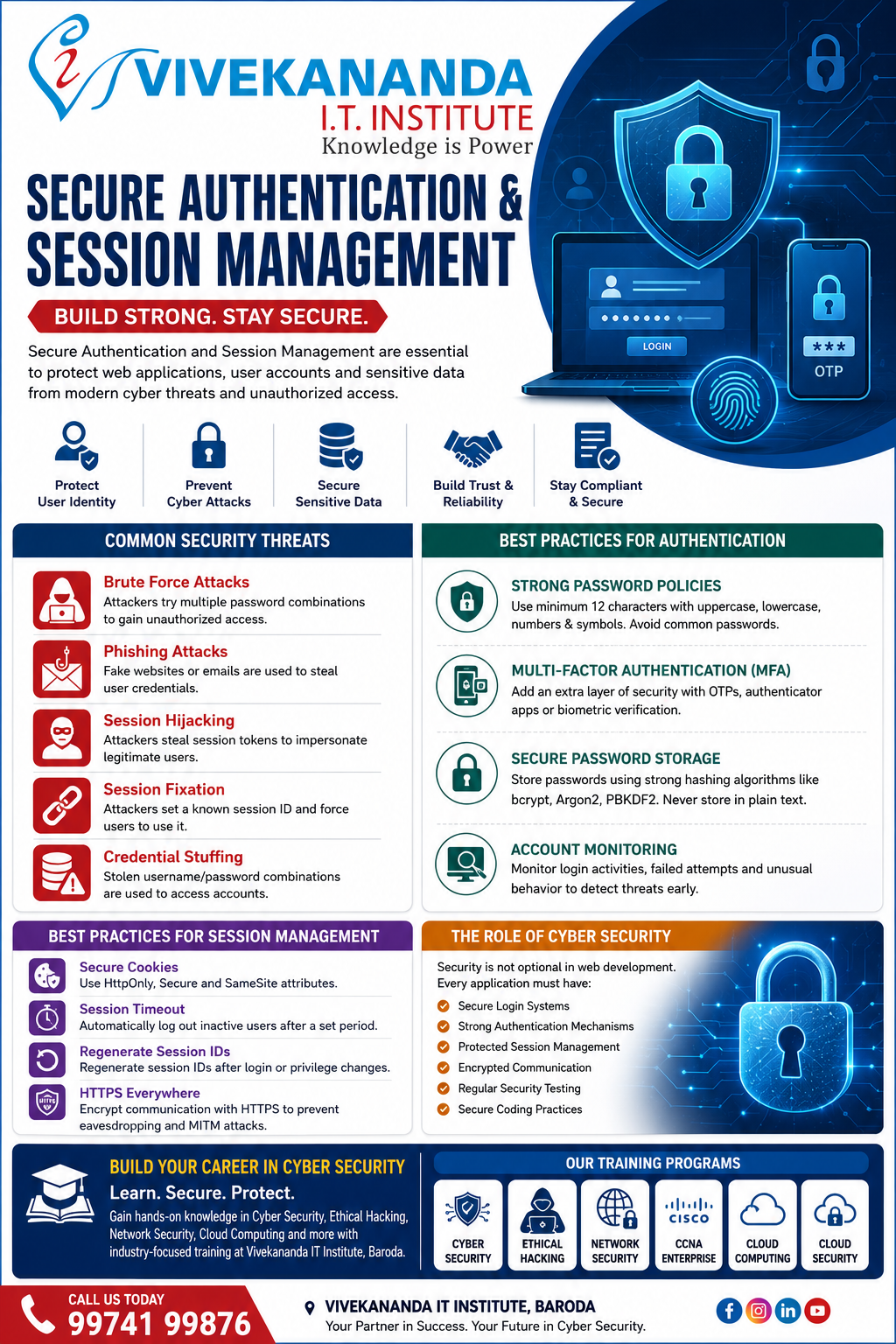
Building Strong Digital Security Through Authentication and Session Protection
As businesses, organizations, and individuals increasingly depend on web applications and online services, protecting user identities and sensitive information has become a top priority. Secure Authentication and Session Management play a crucial role in defending websites and applications against cyber threats, unauthorized access, and data breaches.
From online banking and e-commerce platforms to cloud services and business applications, secure authentication mechanisms help verify user identities, while session management ensures that authenticated users can interact safely with web systems.
At Vivekananda IT Institute Baroda, students and professionals are introduced to modern cyber security practices that focus on securing web applications, protecting user accounts, and implementing industry-standard authentication controls.
Understanding Authentication in Cyber Security
Authentication is the process of verifying the identity of a user before granting access to a website, application, or network resource. It acts as the first line of defense against unauthorized access.
Without proper authentication controls, attackers may gain access to confidential information, customer records, financial data, or administrative systems.
Common Authentication Methods
Modern web applications use various authentication techniques, including:
- Username and Password Authentication
- Multi-Factor Authentication (MFA)
- One-Time Passwords (OTP)
- Biometric Authentication
- Single Sign-On (SSO)
- Certificate-Based Authentication
Implementing secure authentication mechanisms significantly reduces the risk of cyber attacks and account compromise.
Why Secure Authentication Matters
Weak authentication systems often become the primary target for cybercriminals. Poor password practices, lack of additional verification methods, and insecure login systems can expose organizations to serious security incidents.
Potential consequences include:
- Unauthorized access to sensitive information
- Identity theft
- Financial fraud
- Data breaches
- Loss of customer trust
- Regulatory compliance violations
Cyber security professionals must understand how to design and implement secure authentication systems to protect modern digital environments.
What is Session Management?
After a user successfully logs into a web application, the server creates a session to maintain the user’s authenticated state. Session Management refers to the process of securely handling these user sessions throughout their interaction with the application.
A session typically contains information that allows users to navigate different pages without repeatedly entering their credentials.
If session management is poorly implemented, attackers may hijack active sessions and gain unauthorized access to user accounts.
Common Authentication and Session Security Threats
1. Brute Force Attacks
Brute force attacks occur when attackers repeatedly attempt different username and password combinations until they successfully gain access.
Prevention Techniques
- Strong password requirements
- Account lockout policies
- CAPTCHA implementation
- Login rate limiting
- Multi-Factor Authentication
These controls help reduce the effectiveness of automated password-guessing attacks.
2. Credential Stuffing Attacks
Credential stuffing involves using stolen usernames and passwords from previous data breaches to gain access to other websites.
Prevention Techniques
- MFA implementation
- Password uniqueness policies
- Monitoring suspicious login behavior
- Risk-based authentication
Organizations should encourage users to avoid password reuse across multiple platforms.
3. Phishing Attacks
Phishing attacks trick users into revealing login credentials through fraudulent emails, websites, or messages.
Prevention Techniques
- Security awareness training
- HTTPS-secured websites
- Email security solutions
- Domain monitoring
- User verification procedures
User education remains one of the most effective defenses against phishing attacks.
4. Session Hijacking
Session hijacking occurs when an attacker steals or manipulates a user’s session token and impersonates the legitimate user.
Prevention Techniques
- Secure session cookies
- HTTPS encryption
- Session expiration controls
- Randomized session identifiers
- Session token regeneration
Proper session security helps protect user accounts from unauthorized access.
5. Session Fixation Attacks
In a session fixation attack, an attacker forces a victim to use a known session identifier before authentication.
Prevention Techniques
- Regenerate session IDs after login
- Invalidate old sessions
- Secure session handling practices
These measures ensure attackers cannot predict or reuse session tokens.
Best Practices for Secure Authentication
Implement Strong Password Policies
Strong passwords remain an important component of account security.
Recommended guidelines include:
- Minimum length of 12 characters
- Combination of uppercase and lowercase letters
- Numbers and special characters
- Avoid common or predictable passwords
- Regular password review policies
Strong password practices reduce the likelihood of successful password attacks.
Enable Multi-Factor Authentication (MFA)
Multi-Factor Authentication requires users to provide additional verification beyond a password.
Examples include:
- Mobile authenticator applications
- SMS or email OTPs
- Hardware security keys
- Biometric verification
MFA significantly strengthens account security and is considered a critical cyber security control.
Secure Password Storage
Passwords should never be stored in plain text.
Modern applications should use secure hashing algorithms such as:
- bcrypt
- Argon2
- PBKDF2
These algorithms help protect stored credentials even if a database compromise occurs.
Implement Account Monitoring
Organizations should continuously monitor authentication events to identify:
- Suspicious login attempts
- Geographic anomalies
- Multiple failed login attempts
- Unusual account activity
Proactive monitoring improves threat detection and incident response capabilities.
Best Practices for Secure Session Management
Use Secure Cookies
Session cookies should be configured with appropriate security settings:
- HttpOnly attribute
- Secure attribute
- SameSite attribute
These settings help protect session tokens from theft and cross-site attacks.
Enforce Session Timeouts
Inactive sessions should automatically expire after a predefined period.
Benefits include:
- Reduced risk of unauthorized access
- Improved account protection
- Better security compliance
Session expiration is particularly important for sensitive applications.
Regenerate Session IDs
Session identifiers should be regenerated after:
- User login
- Password changes
- Privilege escalation
- Account recovery actions
This prevents attackers from exploiting known session identifiers.
Use HTTPS Everywhere
HTTPS encrypts communication between users and web servers.
Advantages include:
- Protection against eavesdropping
- Data confidentiality
- Protection against man-in-the-middle attacks
- Enhanced user trust
Secure communication is a fundamental requirement for modern web security.
The Role of Cyber Security in Modern Web Development
Security must be integrated throughout the web development lifecycle rather than added after deployment.
Modern web applications should include:
- Secure authentication systems
- Strong access controls
- Protected session management
- Secure coding practices
- Vulnerability assessments
- Penetration testing
- Continuous security monitoring
Developers who understand cyber security principles can create safer and more resilient applications.
Benefits of Learning Authentication and Session Security
Professionals who understand authentication security and session management can:
- Develop secure web applications
- Reduce cyber security risks
- Protect user data and privacy
- Improve application reliability
- Meet security compliance requirements
- Enhance career opportunities in cyber security
These skills are highly valued across industries including IT, finance, healthcare, e-commerce, and cloud computing.
Learn Cyber Security with Vivekananda IT Institute Baroda
As cyber threats continue to evolve, organizations need skilled professionals who understand secure authentication, web security, ethical hacking, and cyber defense techniques.
Vivekananda IT Institute Baroda offers industry-focused training programs designed to help students build practical knowledge in:
- Cyber Security
- Ethical Hacking
- Network Security
- CCNA Enterprise
- Cloud Computing
- Cloud Security
- Web Application Security
Through hands-on learning and real-world scenarios, students gain valuable skills needed to secure modern digital environments.
Conclusion
Secure Authentication and Session Management are essential components of web application security. Strong passwords, Multi-Factor Authentication, secure password storage, protected session handling, and HTTPS encryption help defend systems against cyber threats and unauthorized access.
Organizations that implement robust authentication and session security practices can better protect user accounts, sensitive data, and business operations. As cyber security becomes increasingly important in every industry, understanding these concepts is a valuable skill for developers, IT professionals, and future cyber security experts.
By learning and applying modern authentication and session management techniques, professionals can contribute to building a safer and more secure digital world.