
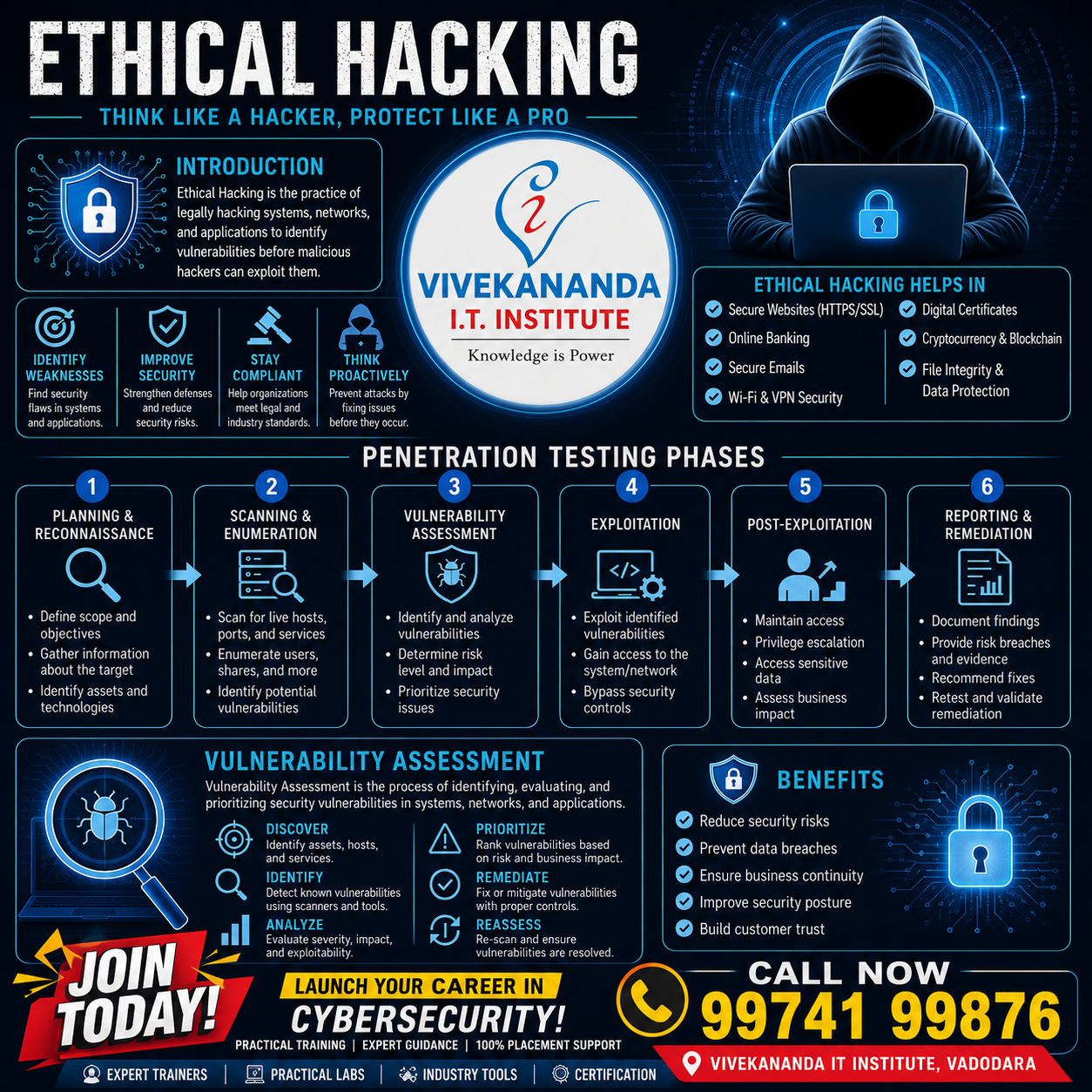
Ethical Hacking: Securing the Digital World
In today’s digital era, cyber threats are increasing rapidly. From personal data theft to attacks on multinational companies, cybersecurity has become one of the most important fields in information technology. This is where Ethical Hacking plays a vital role.
Ethical hackers are cybersecurity professionals who legally test systems, networks, and applications to identify vulnerabilities before malicious hackers can exploit them.
At Vivekananda IT Institute, students are introduced to practical ethical hacking concepts through hands-on cybersecurity training designed for modern IT environments. The institute focuses on building real-world skills that help learners understand how cyberattacks happen and how organizations can defend against them.
What is Ethical Hacking?
Ethical hacking is the process of legally breaking into computers, servers, networks, or applications to test their security strength. Ethical hackers use the same techniques as cybercriminals, but with permission and for defensive purposes.
Ethical Hackers Are Also Known As:
- White Hat Hackers
- Security Analysts
- Penetration Testers
- Cybersecurity Experts
Main Goals of Ethical Hacking
- Detect vulnerabilities
- Improve security systems
- Prevent cyberattacks
- Protect sensitive data
At Vivekananda IT Institute, students learn how ethical hacking helps businesses secure their digital infrastructure against modern cyber threats.
Importance of Ethical Hacking in Cybersecurity
Organizations store huge amounts of confidential information online. If security weaknesses are not identified in time, attackers can exploit them and cause serious damage.
Benefits of Ethical Hacking
1. Identifying Security Weaknesses
Ethical hackers scan systems to find vulnerabilities in networks, servers, and applications before attackers discover them.
2. Preventing Data Breaches
Sensitive customer data, banking information, and business records can be protected through proper security testing.
3. Strengthening Network Security
Organizations improve firewalls, access controls, and encryption methods after ethical hacking assessments.
4. Enhancing Business Reputation
Strong cybersecurity builds trust among customers and clients.
5. Compliance and Legal Security
Many companies perform penetration testing to comply with cybersecurity regulations and standards.
Students at Vivekananda IT Institute gain practical exposure to these security concepts through industry-oriented cybersecurity training programs.
Penetration Testing Phases
Penetration testing, also called Pen Testing, is a controlled cybersecurity assessment used to simulate real cyberattacks. It helps organizations discover vulnerabilities before hackers can exploit them.
The penetration testing process is divided into several important phases.
1. Planning and Reconnaissance
This is the first stage of penetration testing.
In this phase, ethical hackers gather information about the target system or network.
Activities Include:
- Collecting IP addresses
- Identifying domain information
- Discovering open ports
- Understanding network architecture
- Gathering employee or company information
Types of Reconnaissance
Passive Reconnaissance
Information is collected without directly interacting with the target system.
Examples:
- Searching public websites
- Social media analysis
- WHOIS lookup
Active Reconnaissance
Direct interaction with the target system occurs.
Examples:
- Port scanning
- Network mapping
- Ping sweeps
This phase helps ethical hackers understand the target environment before testing begins.
2. Scanning Phase
During scanning, hackers identify active devices, open ports, services, and vulnerabilities.
Common Scanning Techniques
Port Scanning
Used to identify open communication ports.
Vulnerability Scanning
Detects outdated software and security weaknesses.
Network Scanning
Maps devices connected to a network.
Popular Tools
- Nmap
- Wireshark
- Nessus
- OpenVAS
Students learning at Vivekananda IT Institute often practice these tools in controlled lab environments to understand real cybersecurity scenarios.
3. Gaining Access
In this phase, ethical hackers attempt to exploit vulnerabilities.
Possible Attack Methods
- SQL Injection
- Password Cracking
- Malware Simulation
- Exploiting Software Vulnerabilities
- Wireless Attacks
The goal is to determine how much damage an attacker could cause if the vulnerability is exploited.
This phase demonstrates the real impact of security weaknesses.
4. Maintaining Access
After gaining access, testers check whether attackers could maintain long-term access within the system.
Activities Include
- Privilege escalation
- Creating backdoors
- Testing persistence mechanisms
- Simulating advanced threats
This phase helps organizations understand how dangerous an actual cyberattack could become.
5. Analysis and Reporting
This is one of the most important phases of penetration testing.
Ethical Hackers Prepare Detailed Reports Containing:
- Vulnerabilities discovered
- Risk levels
- Exploitation methods
- Screenshots and evidence
- Security recommendations
The final report helps organizations improve their cybersecurity protection.
At Vivekananda IT Institute, students are trained not only in technical testing but also in professional cybersecurity reporting skills required in the IT industry.
Vulnerability Assessment
A Vulnerability Assessment is the process of identifying, classifying, and prioritizing security weaknesses in systems, networks, and applications.
Unlike penetration testing, vulnerability assessment mainly focuses on discovering vulnerabilities rather than exploiting them.
Objectives of Vulnerability Assessment
Detect Weaknesses
Identify outdated software, weak passwords, and configuration issues.
Improve Security
Help organizations patch vulnerabilities before cybercriminals exploit them.
Reduce Cyber Risks
Minimize the chances of successful cyberattacks.
Ensure Compliance
Meet cybersecurity standards and regulations.
Types of Vulnerability Assessments
Network-Based Assessment
Checks network devices like routers, switches, and firewalls.
Host-Based Assessment
Inspects computers, servers, and operating systems.
Wireless Assessment
Tests Wi-Fi security and wireless encryption methods.
Application Assessment
Scans websites and software applications for vulnerabilities.
Database Assessment
Examines database security settings and access controls.
Common Vulnerability Assessment Tools
Nessus
Widely used vulnerability scanner for detecting system weaknesses.
OpenVAS
Open-source vulnerability management tool.
Nikto
Web server vulnerability scanner.
Burp Suite
Popular tool for web application security testing.
Qualys
Cloud-based vulnerability management platform.
Students at Vivekananda IT Institute are introduced to these industry standard tools to prepare them for real cybersecurity careers.
Difference Between Vulnerability Assessment and Penetration Testing
| Vulnerability Assessment | Penetration Testing |
|---|---|
| Identifies vulnerabilities | Exploits vulnerabilities |
| Focuses on detection | Focuses on attack simulation |
| Automated scanning | Manual and automated testing |
| Lower risk | Higher risk |
| Provides security overview | Demonstrates real attack impact |
Both are essential components of modern cybersecurity strategies.
Career Opportunities in Ethical Hacking
Ethical hacking offers excellent career opportunities due to increasing cyber threats worldwide.
Popular Career Roles
- Ethical Hacker
- Penetration Tester
- Security Analyst
- SOC Analyst
- Cybersecurity Consultant
- Network Security Engineer
Cybersecurity professionals are in high demand across industries including banking, healthcare, IT, e-commerce, and government sectors.
Why Learn Ethical Hacking?
Learning ethical hacking helps students:
- Understand cyber threats
- Secure computer networks
- Develop practical cybersecurity skills
- Build careers in the IT security industry
- Protect organizations from cyberattacks
At Vivekananda IT Institute, learners receive practical exposure to network security, penetration testing, vulnerability assessment, and ethical hacking tools through industry-focused training programs.
Conclusion
Ethical hacking is one of the most exciting and essential fields in modern cybersecurity. By understanding penetration testing phases and vulnerability assessment techniques, organizations can strengthen their security posture and defend against cyber threats effectively.
As cybercrime continues to evolve, the demand for skilled ethical hackers is increasing rapidly. Institutes like Vivekananda IT Institute are helping students in Vadodara build strong foundations in networking and cybersecurity through practical learning and hands-on ethical hacking training.